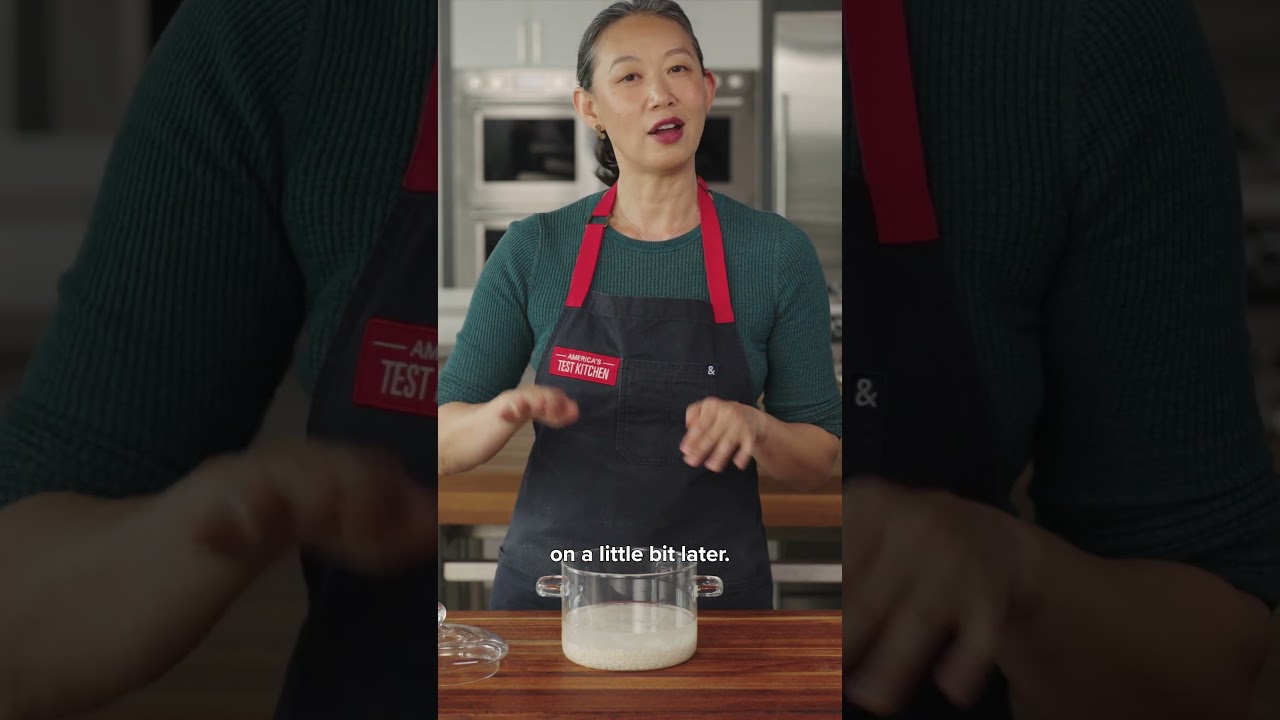
How to Make a Perfect Bowl of White Rice Without a Recipe

If you’re not into following a recipe, Lan Lam shows you a tip so you can make perfectly fluffy white rice every time.
Subscribe to America’s Test Kitchen:
Watch full episodes of America’s Test Kitchen and Cook’s Country for free on our new YouTube channel:
Watch More!
In The Test Kitchen:
The Taste Test:
Techniquely With Lan Lam:
Most Popular:
Follow America’s Test Kitchen:
Instagram:
Pinterest:
TikTok:
Facebook:
Twitter:
At America’s Test Kitchen, we investigate every aspect of cooking—recipes, equipment, ingredients, and techniques—with a goal to empower and inspire home cooks. Since 1992, our team of 50+ cooks, editors, and culinary creatives ask a lot of questions—and do a lot of testing—so that you get dependable, delicious recipes, comprehensive guidance, and thorough and unbiased equipment and ingredient reviews. You can find us in the pages of Cook’s Illustrated magazine, on our television shows America’s Test Kitchen and Cook’s Country, in dozens of best-selling cookbooks, and via the 14,000+ recipes, reviews, and classes available on our website and app. Whether you’re in search of a great weeknight meal or an impressive dinner-party dish, we’ve done the testing to deliver reliable recipes and comprehensive cooking info to your home kitchen. Bring your curiosity, and we’ll make you a better cook.
#AmericasTestKitchen #CookingTutorial #FoodScience
When you choose to purchase our editorial recommendations from the links we provide, we may earn an affiliate commission.
source
thank you for the tips
I’m surprised atk decided to recommended such an imprecise technique
Excellent TIP
Wow did not think that measuring your rice was that difficult.
One knuckle rice, two knuckle water.
The reason this works is because the rice is granular enough that, if you filled it up to exactly the top of the rice, the individual grains will already be surrounded with almost enough water. The extra water then acts as a timer, holding the rice at the proper temperature without burning, as the liquid water absorbs heat energy to turn into a gas. As the rice cooks, it absorbs more and more water, while the water is also evaporating — but only at the surface. The point where the absorption and vaporization meet lines up nicely with about a knuckle-depth of excess water. If you tried this in a perfectly sealed, pressurized vessel, that would be way too much water, and you'd get mush. If you left the lid off, the water would evaporate faster and you'd get crunchy rice.
haiyah wwii is over use technology!
The type of rice requires different amounts of water
Sounds like a good strategy. People keep telling me that they can't make rice and I asked them if they've tried following the directions and the answer is no😂
Another method i found is to just measure water volume about 1:1 to your rice volume. This is very handy because whatever glass or cup you use to take the rice, you can use it to measure the water too.
But key thing is to not strain the rice thru corlander, just tilt the pot enough to strain most of the water out. This works great for too little rice in pot (uneven surface) and also to know your water adjustment for firm/softness if you just use rice cooker
The secrets out yall!
Love me some Lan as much as I love me some steamed white rice! & I absolutely love white🍚😋
get a rice cooker
Love you but disappointed. I was convinced this worked and had sh*t*y rice for years. Only an f'ing moron (which apparently I am) would think this would work. 1 part rice to 2 parts rice is the complete answer. If you can't measure find a different universe.
I want a clear pot like that!
My mainland Chinese mom taught me this technique too but explained it as a palm thickness of water on top, which is probably equivalent to a knuckle.
So, with the knuckle method your fingertip is on top of the rice, not down to the bottom of the pot? That's the one thing I've never seen mentioned. Thank you.
Lan Lam!!
Perf!!!!! I don't need a extra toxic rice cooker 🤢🤢🤢🤮
Finger measure forever!
I use a mug to "measure" my rice and just eyeball. Then I eyeball 2 of the same measurements of liquid.
It makes me fat I don’t walk too much
Yes! You were rich!!!! It
Love it!!!!!! I could eat rice everyday 🥣🥄