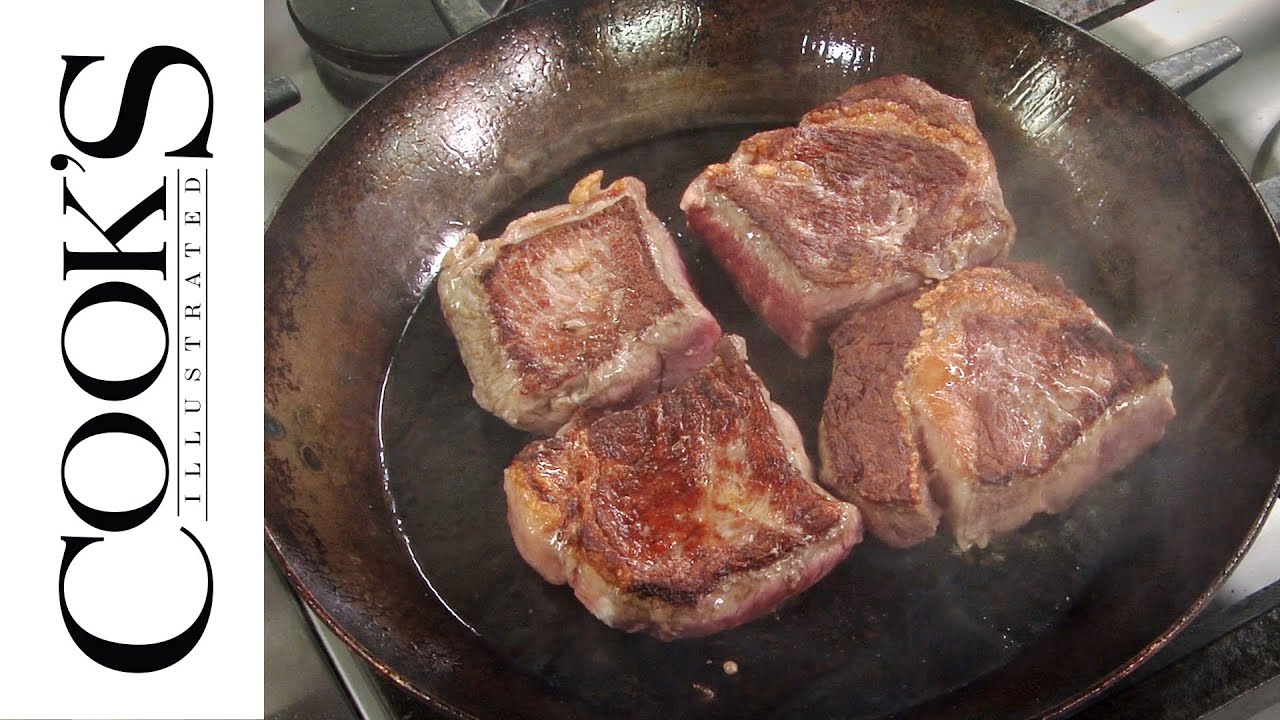
Equipment Review: Best Carbon-Steel Skillets (Can This One Pan Do It All?) & Our Testing Winner

Buy the Winning Carbon-Steel Skillet:
Full testing details and ranking chart:
What if one pan could do everything the best traditional stainless-steel, cast-iron, and nonstick pans can do—and, in some cases, even do it a little better?
We tested 8 carbon-steel skillets to find the best one:
Matfer Bourgeat Black Steel Round Frying Pan, 11 7/8″
Blu Skillet Ironware 13″ Fry Pan
Mauviel M’steel Round Fry Pan, Steel Handle 12.5″
Turk Heavy Steel Frying Pan 11″
De Buyer Mineral B Frypan, 12.6″
Paderno World Cuisine Heavy Duty Polished Carbon Steel Frying Pan, 12 1/2″
Lodge 12″ Seasoned Steel Skillet
Vollrath 12 1/2″ Carbon Steel Fry Pan
Are Carbon-Steel Knives Worth It? Watch now:
Are You Using the Best Cutting Board? Watch now:
Even if you’ve never heard of a carbon-steel skillet, you’ve almost certainly eaten a meal made in one. Restaurant chefs use these pans for all kinds of tasks, from searing steak to sautéing onions to cooking eggs. French omelet and crêpe pans are made of carbon steel, as are the woks used in Chinese restaurants. Even Julia Child had a few carbon-steel pieces alongside her familiar rows of copper cookware. In European home kitchens, these pans are hugely popular. Somehow, though, despite their prevalence in restaurants, they’ve never really caught on with home cooks in the United States. Given their reputation for being as great at browning as they are at keeping delicate foods from sticking, we wondered if it was time that changed.
We bought seven carbon-steel skillets, all as close as possible to our preferred sizeof 12 inches for a primary skillet, priced from $39.95 to $79.95. For fun we also threw in a $230 hand-forged version made in Oregon. Bearing in mind carbon steel’s multipurpose promise, we decided on a range of recipes for our testing: frying eggs, turning out cheese omelets, pan-searing steaks, and baking the traditional French upside-down apple dessert known as tarte Tatin, which begins on the stove and moves to the oven. Along the way we’d evaluate the skillets’ shape, weight, handle comfort, and maneuverability. Washing the pans after every test would let us judge how easy they were to clean and maintain. Our key question: Could this one type of pan actually make owning the other skillets we’ve always had in our arsenal—stainless-steel tri-ply, cast-iron, and nonstick—more of an option than a necessity?
ABOUT US: Located in Boston’s Seaport District in the historic Innovation and Design Building, America’s Test Kitchen features 15,000 square feet of kitchen space including multiple photography and video studios. It is the home of Cook’s Illustrated magazine and Cook’s Country magazine and is the workday destination for more than 60 test cooks, editors, and cookware specialists. Our mission is to test recipes over and over again until we understand how and why they work and until we arrive at the best version.
Each week, the cast of America’s Test Kitchen brings the recipes, testings, and tastings from Cook’s Illustrated magazine to life on our public television series. With more than 2 million viewers per episode, we are the most-watched cooking show on public television.
More than 1.3 million home cooks rely on Cook’s Illustrated and Cook’s Country magazines to provide trusted recipes that work, honest ratings of equipment and supermarket ingredients, and kitchen tips.
If you like us, follow us:

Damn, the Matfer Bourget has been jacked up to $160 CAD on Amazon 🙁
The Matfer Bourgeat has doubled in price since this video, which is a shame.
protein: the recommended pan Is very very heavy and the handle is very very long. it is very hard to handle even small size and talking from a guy with muscle….
Keeping delicate foods from sticking? Ha, that is why I won't buy anymore. They do not keep foods from sticking, too hard to season.
$44 is now up to $75. Damn these greedy corporations.
These now have DOUBLED in price post Covid/19 / Joe (INFLATION) Biden☝️🤨
I just love the cut at 1:19 to hide the fact that the pan doesn't fit in the oven due to its handle.
I love this channel!!!
Best presentation and helpful
Had to dislike video too many f_cking ads a_shole!
Any issues with warping on induction stovetop? Anyone with practical experience, please reply
What is the role of salt and potato skins in seasoning?
Can someone explain this?
Thank you for this excellent, succinct, and succulent video.
what do you really recomend for somebody like to cook and want to be healthy, Carbon Steel pan or stainless steel 18*10 pan?
DAMN she is KNOWLEDGEABLE that's for sure 👍🏾… she's so Clear & Accurate
Have you tested on induction ranges? I am finding that it won't heat evenly and is hard to season.
The pan is now 130$
Have the stoves in the United States are electric and carbon steel warps on electric. That’s probably why they haven’t really taken off here. I have a carbon steel walk with a rounded bottom due to my electric stove. Makes it very hard when your pot spins.
2:00 and 3:36
Too bad the winner is almost doubled in price now
Great Infor, direct & to the point. Thank you
7 years later the $40 has turned into $73
@ around 3:25 she says to never scrub with an abrasive or use soap on carbon steel pans. Then @ around 3:37 it looks just like someone's using a sponge with soap on the pan. I'm totally confused.
I'm torn between carbon steel and stainless steel. What do you guys think ?
Ok. I’ve made a life altering decision. I’m going to buy one great carbon steel pan and maybe one new decent non stick and be rid of all the rest with the exception of my cast iron. I should be good for the rest of my life with pans. One can pile up too many pans and lids.
You lyning B, this is more then $44 on amazon.Thumbs down.
You can use dish soap with cast iron and carbon steel. That idea is leftover from when soap used to have lye in it. Detergent shouldn't be able to remove covalently bonded molecules from a pan.
Don't put it in the dishwasher though! Dishwasher tablets are far more corrosive.
I wish I see this . Got my blue carbon steel pan yesterday. I did the seasoning wrong. The burnt spot remain uneven
Is there an alternative to the potatoe peels?
"Brown and black is beautiful." – Uncle Scott's Kitchen
How do I season the outside of the skillet if using the potato peel method?
Do I just do separate runs in the oven like you would with a cast iron?
$230 in 2015, It's $380 now.
I read multiple reviews on Amazon of the Matfor Bourgeat Black Steel Round Frying Pan. All said it warped. Not a problem if using a gas burner stove. A real problem for electric stoves with flat surfaces, such as glass.
Braeden Zamarron, I just read your comment and I wholeheartedly agree with you. This lady is obviously bright and very good at what she does in this format.
that omelette is nightmare fuel tho
She is fantastic!
I love cast iron, every time I go to a place that sells it I have to look at it even though I really dont need anymore …bought a debuyer omelet pan and fell in love with it….it does eggs better than cast iron imo, though nothing beats cast iron corn bread …the downside is carbon steel will lose its seasoning easier with tomato sauces etc…so I use it for browning meats and breakfast foods …I now also have a matfer 11-7/8 pan for my big skillet use, much easier to maneuver than a 12 inch cast iron skillet …here is a tip, you can also season these pans in the oven, I would keep the temp no higher than 400 degrees….a gas burner stove does a great job getting the sides seasoned too
What about the ones with coated handles that do have oven temp limits?
buying a CS pan is self harming
I don’t know what I’m doing wrong my pan seems to be perfectly seasoned but yet everything sticks to it. My cast iron is great nothing sticks. I’m throwing my carbon steel out. Total waste of money
2:27 what did I do wrong? – my skillet did not get brown at all (I bought the Matfer Bourgeat pan)
I wish I would have got these instead of a stainless steel set
the way carbon steel sears chicken, imo, is better than cast iron. just ate some right now. Taste better than cast iron.
De Buyer Mineral B Pro. Very heavy, beautiful pan. Best by far in my opinion.
Great video, thanks.