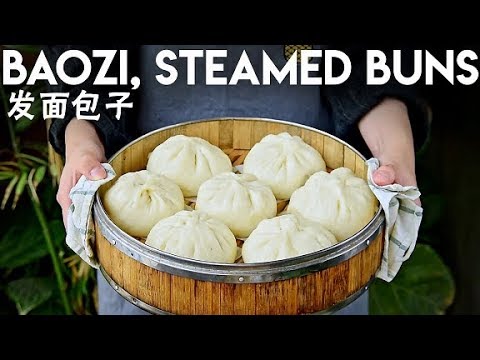
Bao Zi, Fluffy Steamed Pork Buns (发面包子)

So today we wanted to show you how to make Baozi, a.k.a. ‘Bao Buns’ or stuffed steamed buns. Now there’s a lot of different varieties of Baozi dough – we wanted to show you how to make fully risen Baozi, i.e. the sort that you’d often find at breakfast street food joints in China.
So know that this recipe isn’t even close to exhaustive. We only chose one filling – pork. There’s also vegetable, pork and vegetable, beef, chicken… really whatever. We actually cut out a veg Baozi recipe from the video for time reasons, so check out the Reddit post for a recipe for that as well.
As always, the full, detailed recipe is over here on /r/cooking:
And check out our Patreon if you’d like to support the project!
Outro Music: “Add And” by Broke For Free
ABOUT US
—————————————————————————————–
Learn how to cook real deal, authentic Chinese food! We post recipes every Tuesday (unless we happen to be travelling) 🙂
We’re Steph and Chris – a food-obsessed couple that lives in Shenzhen, China. Steph is from Guangzhou and loves cooking food from throughout China – you’ll usually be watching her behind the wok. Chris is a long-term expat from America that’s been living in China and loving it for the last eleven years – you’ll be listening to his explanations and recipe details, and doing some cooking at times as well.
This channel is all about learning how to cook the same taste that you’d get in China. Our goal for each video is to give you a recipe that would at least get you close to what’s made by some of our favorite restaurants here. Because of that, our recipes are no-holds-barred Chinese when it comes to style and ingredients – but feel free to ask for tips about adaptations and sourcing too!
source


Hey guys, a few notes:
1. Something I totally forgot to say in the narration, chill your filling before you wrap. Tossing it in the freezer for 30-60 minutes before wrapping will make your job a lot easier.
2. To expand on the hydration bit, what we'd suggest is first mixing the sugar/yeast with 100 grams of water, then slowly adding more water in from there. We used two different flours when testing – one needed an additional 40 grams, while one (this one) needed 25 grams. This flour was fresher, and many other Baozi recipes are also 50% hydration, so that's what we went with in the narration.
3. Some Baozi doughs can get up to 55% or 60% hydration. The tradeoff is this: lower hydration Baozi are more difficult to wrap, but higher hydration doughs have a more difficult time holding their shape.
4. Steph shapes the Baozi into a ball before wrapping, which is a less common technique. The advantage of shaping before rolling is to more easily get the wrapper into a nice round shape.
5. Depending on what you want the final result of your Baozi to be, feel free to adjust the final proofing time. We were flirting with the upper limit there in order to get real fluffy Baozi. If you want a smaller, denser Baozi… proof for 15-20 minutes instead.
6. There are also Baozi that use laomian – i.e. a sourdough starter – in place of yeast. We were having issues with the ratios when testing, and decided to use a yeast dough here. When we do a ban famian Baozi (half risen Baozi), we'll show you how to do the sourdough technique.
7. We also really wanted to show how to make a vegetable filling – even filmed it and everything. Ended up hitting the cutting floor because otherwise it might've knocked the video over 10 minutes. Full recipe for that will be in the Reddit post.
8. Apologies for writing "Bao Zi" in the title – looks weird to me, too. The SEO was just way better than "Baozi", and we were already choosing to forgo the heavily searched for 'bao buns' lol
😋😋😋
Since i don't eat pork, i substitute this recipe with chicken and egg. I also skip the cooking wine and keep the rest the same. It's still does an amazing job, I'll make this for my lunch everyday now 😸❤️
I just made these yesterday as of the time of typing this comment and they’re pretty good it took two days to make and I used ground pork instead of Chinese BBQ pork they taste like a meaty biscuit
Great video!
wow
Great video
Why don't you just write the recipes in the info box under the video? I can't read it because I'm not on Reddit.
Finally I can make Sakomoto's family happy.
3:14 dough rolling and shaping
To much time to chase down recipe from on line
Writing down for recipe down ,please,thanks
30 mins will fully cook the meat? How about chicken or turkey?
Amazing video making these at work today for family meal hahaha
Hi! How can i store my unused bao zi dough, unfilled and unshapen?
Literal Steamed Hams
Or $10 at the Chinese restaurant down the st. Lol jk, but man those are a lot of steps..
this baozi is really not good…
Lopez Betty Davis Brenda Johnson Anthony
How should you approach proofing them if all the buns you make up cant fit into your steamer at one time?
so i don't have the time to knead dough. is there a can of dough i can buy at walmart to cut down prep time?
yummyies
As a very lazy person, I hate when dishes I love involve making a form of bread. Guarantees I'll never make it at home, and forever be a slave to the freezer section or the occasional restaurant
Legend says that a man who never eats pork buns is never a whole man.