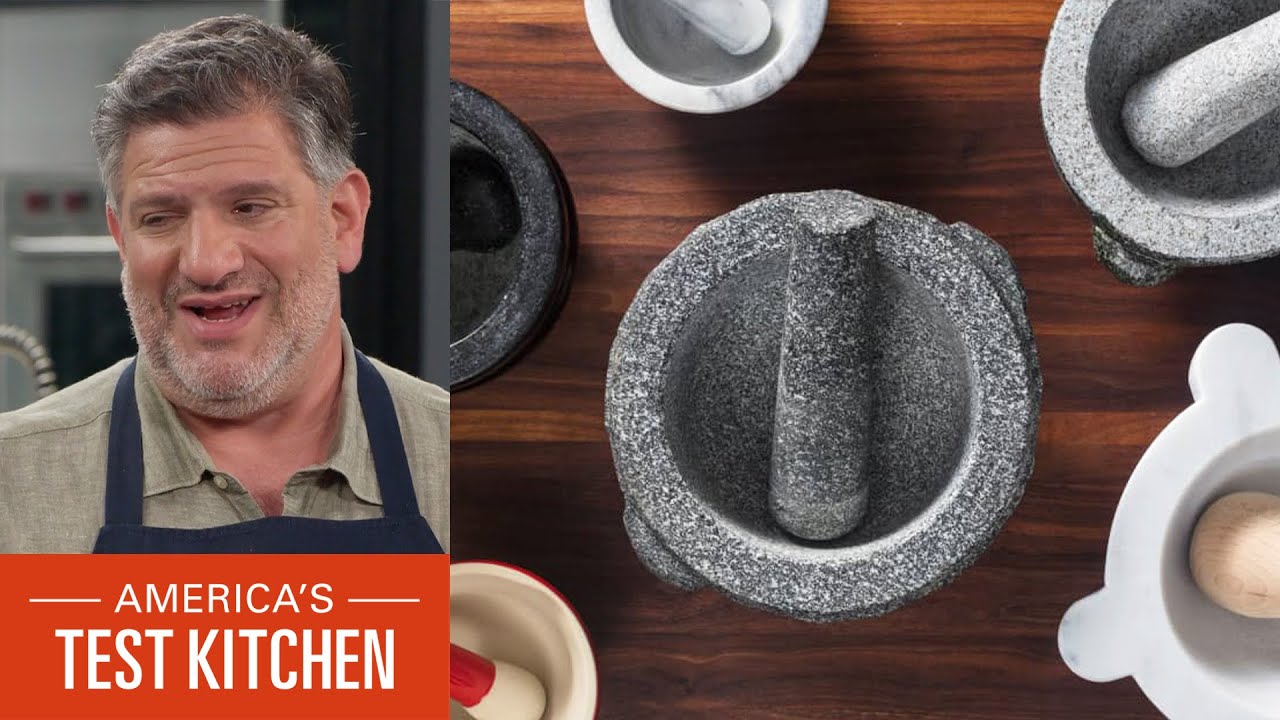
Equipment Expert’s Guide to Mortars and Pestles
Equipment expert Adam Ried shares with host Julia Collin Davison his top picks for mortars and pestles.
Read our full review:
Buy our winning Mortar & Pestle:
Browse our latest recipes:
ABOUT US: Located in Boston’s Seaport District in the historic Innovation and Design Building, America’s Test Kitchen features 15,000 square feet of kitchen space including multiple photography and video studios. It is the home of Cook’s Illustrated magazine and Cook’s Country magazine and is the workday destination for more than 60 test cooks, editors, and cookware specialists. Our mission is to test recipes over and over again until we understand how and why they work and until we arrive at the best version.
If you like us, follow us:


No Olive Wood Mortar and Pestle?
Trimakasih sudah ber bagi video tentang alat tradisional yang bagus
I was just wondering, don't you have to grind in a circular motion in a mortar and pestle, and not wham it down? I fond it way more effective in mine and also it doesn't get as much pieces flying around…
Good timing. I enjoyed your video but, I would like you to address curing your new mortar and pestle. I just bought one and ended up taking it back. I found instructions online to put white rice in the mortar and pestle with a little water and go until you make mush and to do that three times. Of course rinsing it out well no soap! And letting it dry in between. And I was still getting powdered Granite on the surfaces. Something I don't know?
So much talk of pounding. 🤭
For dry spices, give me a spice/coffee grinder over a mortar any day.
I got my giant one at an estate auction for $13 it is perfect exactly what ive been looking and a fantastic price
Just get a molcajete from any Mexican market.
I used a plate shaped mortar made from stone, used not by pounding but more like grinding as in dragging the pestle across mortar surface.
E Walker not @ewalker1057 – These tests of appliances are kitchen gadgets some money and frustration. Nothing like buying something only to find out it is not the best. Really appreciate it since I recently purchased the spices for garam masala.
What is with the wall behind them?
#adamcandyyummy! he always makes my day!
Good information but waaayyy off on the price of the "winning" M&P.
I mainly use mine (small marble on marble) for grinding eggshells for my plants
Had mine for decades. Use it for spices, pounding together ginger and garlic, fermented black beans, and now daily I use it for my dog’s various medication so I can stir them into her breakfast yogurt.
Surprised the Japanese suribachi wasn't included in the comparison.
I got rid of mine when I just couldn't ignore the wear on them anymore. The stone that wears is going into your food. Years later I watched a documentary on ancient Egyptians, and there was commentary on how their teeth were evenly worn down, and it initially confused researchers. They theorized that it was stone mills that were the culprit. As grains were milled, there was some amount of stone dust that was also produced. Years of eating the stone dust had eventually worn down their teeth.
Boy was I thankful I had gotten rid of my stone m&p.
I saw a black marble mortar & pestle at IKEA years ago that my mom bought, and she loves it.
Just chew and spit, no mortar and pestle needed!
/jk
I was taught with a molcajete, but I love collecting them ……I dont care, tiny, small large.etc etc ………lol