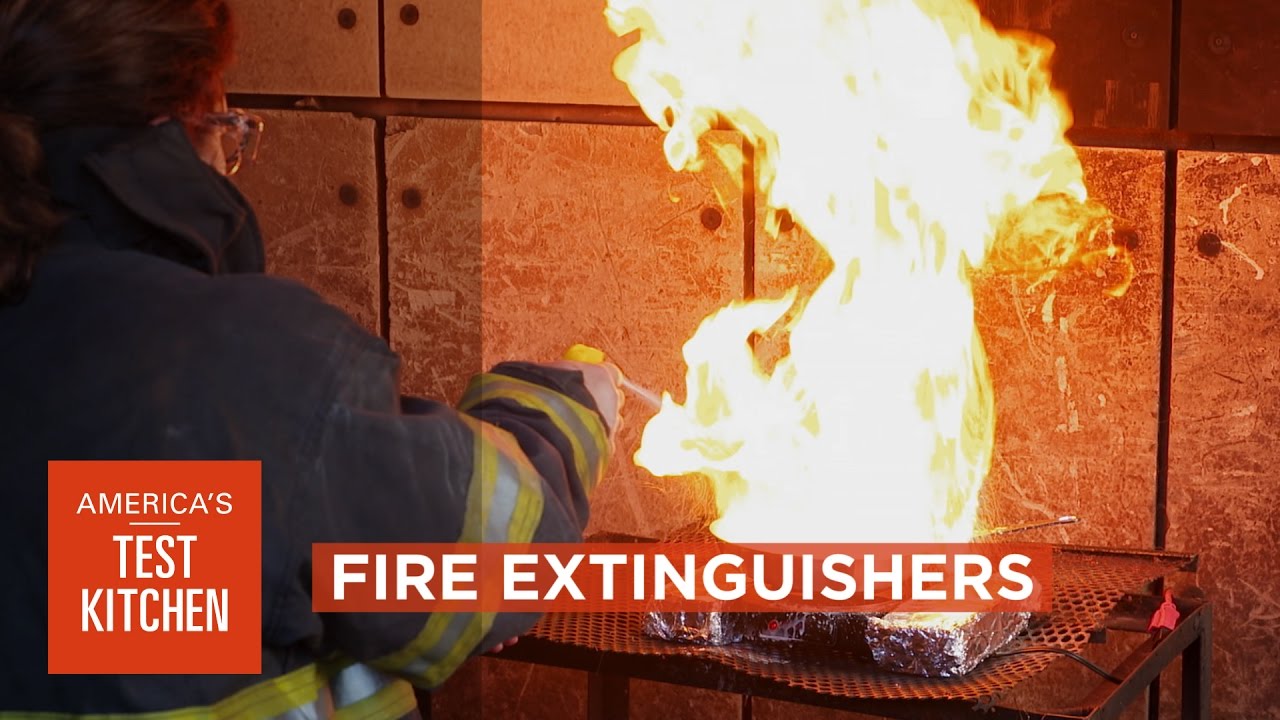
Equipment Review: Best Fire Extinguishers for Home Kitchens & Our Winner (& Kidde Recall Update!)

RECALL UPDATE: Kidde has issued a recall of all of its fire extinguishers with plastic handles, including our winning model FA110 (or FA110G) and the not recommended model RESSP. If you have purchased either model, go to Kidde.com and select Product Safety Recall Notice for more information, or call the Kidde Customer Support Line at 855-271-0773 from 8:30 a.m. to 5 p.m. EST Monday through Friday and 9:00 a.m. to 3:00 pm EST on Saturday and Sunday to request a free replacement fire extinguisher (it will be a different model), and for instructions on returning the recalled unit, as it may not work properly in a fire emergency. In the meantime, we recommend our second and third place models, the First Alert Tundra spray and the Amerex 2.5 Lb ABC Dry Chemical Fire Extinguisher. While both had minor ease-of-use issues, we found both effective at putting out fires.
Buy First Alert Tundra spray:
Buy Amerex 2.5 Lb ABC Dry Chemical Fire Extinguisher:
Behind the Testing:
Full testing details and ranking chart:
We tested 8 fire extinguishers to find the best one:
Kidde ABC Multipurpose Home Fire Extinguisher
First Alert Tundra Fire Extinguishing Spray
Amerex 2.5 lb ABC Dry Chemical Fire Extinguisher
Fireaway Fire Blanket
Kidde RESSP Kitchen Fire Extinguisher
Fire Gone Fire Suppressant
First Alert Kitchen Fire Extinguisher UL Rated 5-B:C
Stovetop Firestop Rangehood
When you have only seconds to put out a kitchen fire, you want an extinguisher that’s easy to use and effective. We were shocked at how many aren’t. What’s #1 in terms of kitchen safety?
We review the best (and worst) gas grills under $500:
Why we love carbon-steel skillets—and which pan’s our favorite:
WINNING TRAITS OF A GOOD FIRE EXTINGUISHER
– Easy to operate, with intuitive design and clear instructions on extinguisher
– Quick, effective, and thorough at extinguishing both grease and cloth fires
– Easy-to-read pressure gauge so you know when to replace extinguisher
WHAT WE EXAMINED
We tested eight fire extinguishers, including four traditional pressurized canisters, two aerosol sprays, one fire blanket, and a self-operating canister that attaches to the hood over a stove. In two separate rounds of testing, we allowed vegetable oil to catch fire in a hot skillet and a dish towel to ignite from touching a lit burner. We used the extinguishers to put out these fires, timing the results and rating the extinguishers on ease of use, performance, and, to a lesser extent, cleanup. Scores from both tests were combined to reach our final ranking. Information about fire suppressant material in extinguishers was provided by manufacturers. Models were purchased online and appear in order of preference.
TIME TO UNDERSTAND OPERATION: Time elapsed between when we picked up the product and when we began using it.
TIME(S) TO PUT OUT GREASE AND TOWEL FIRES: Time elapsed between when we started spraying/smothering the fires and when the fires were extinguished.
EASE OF USE: We evaluated how simple and intuitive the extinguishers were to operate, taking into account that we were working quickly, under pressure, with no preparation (to simulate a real fire emergency).
PERFORMANCE: Models that extinguished both types of fire quickly and thoroughly rated highest.
CLEANUP: Extinguishers that produced less mess and fumes rated higher, although we gave more weight in our ranking to their performance and ease of use.
ABOUT US: Located in Boston’s Seaport District in the historic Innovation and Design Building, America’s Test Kitchen features 15,000 square feet of kitchen space including multiple photography and video studios. It is the home of Cook’s Illustrated magazine and Cook’s Country magazine and is the workday destination for more than 60 test cooks, editors, and cookware specialists. Our mission is to test recipes over and over again until we understand how and why they work and until we arrive at the best version.
If you like us, follow us:




1:51 Thats not what she said at the picnic !
'Bigger is not always better'
That's what she said…
It's better to be cleaning up residue from the extinguisher than to watch your home burn down.
If you even think you might need the extinguisher don't hesitate, if you hesitate it might be too late to control the fire with a residential extinguisher.
Most stupid thing to use in case of a small kitchen Fire is an ABC powder extinguisher. Yes you can extinguish the Fire easily bud the bigger problem comes after the job. The whole kitchen and more is covered with the corrosive powder thus causing even more damage than the small fire does. Better use a foam extinguisher type ABF. So you won't have to clean up the mess a powder extinguisher leaves behind 😉
Is a sad day for fire protection when kidde is recommended before amerex…
Once I had put some cooking oil in a iron skillet, turned the stove on and waited for it to heat up. While I was waiting, I stepped into the living room to watch TV, which was only a few steps away, being it was a condo. I guess I stood there too long, next thing I smelled smoke? When I turned to look, the flames were nearly touching the ceiling?! I ran back into the kitchen, assessed what I needed to do… I grabbed a big ceramic dinner plate and covered the skillet. That of course did the job quite quickly.
Another fire solution would've been "Baking Soda."
BC fire extinguisher on a class a fire: discharging problems… I was really interested, if the BC fire extinguisher could have extinguished an A type fire.
4:25 if you read the instructions for that kind of extinguisher, it's a 1-time use can, and you have to use the entire can in 1 go, otherwise you will not keep the flames from reigniting. The mess it creates is irrelevant if the objective is to stop the fire.
Use halotron. No more spending hours cleaning up powder from the extinguisher in the kitchen
This is her opinion and not necessarily correct.
Yeah, the best job for a pyromaniac
Thank you this is very important information.
I've had one stove fire underneath a pan and it was pretty big. I pulled the pan off and through salt on it and it went out immediately but I want an extinguisher.
Kidde now also makes a specific white kitchen extinguisher. The UL previously had no standards for these, but does now (K). The bottle is the same, but the nozzle makes a wider spray at less pressure, so it will not blowing burning oils around to spread fires.
Same price, too. Very much worth looking at.
Bad recommendation. Kiddie is a budget fire extinguisher that wouldnt do anything to a fire.
That's because you didn't put enough oil in the pan to create the fuel needed for the flames to grow big enough to reach the fire stop.
I just purchased two 2.5 lb. First Alert extinguishers for an RV…also considering outdoor/engine fires. Both standard red coded. A, B, and C. How do they measure up to Kidde? Thanks.
You only had one person test it
Element first extinguishing stick is far superior to all of them.
There are better extinguishers that are more reliable… Nearly all of them are pull pin, point / sweep and shoot.
Flour
Please don't make any more recommendations videos,, especially videos about safety,
Omg. As an engineer, I can’t believe the mistakes in this video. First, the hanging auto extinguisher didn’t work because the fire simply wasn’t big enough. It did a good job once the fire was close. This lady had long exposed HAIR during the testing and they didn’t even put a hat on her.
Thank you. Incredible video!
Great presentation but your working with a 65+ yr old technology and all the issues with caking, and rusting. Check out the revolutionary technology of The Rusoh Eliminator Self Service and Self Reloadable Fire Extinguisher from Fire Technology Innovations: https://www.teamfti.com/eliminator
You call pan of cooking oil burning a house fire??? Just cover it with a lid and you are done Karen, no fire extinguisher needed.
The reason why one fire extinguisher didint work is cuz its recalled it has plastic head
It’s a fuse that triggers that little thing that’s more a thing for if the fire starts to get giant and hit the ceiling
Lol totally subjective. If your going to use them use them the same. The first alert did fine so what if it leaves a mess like most extinguishers and if used right the fire won't reignite. Better a small mess putting out a fire than a totally burned down house.
I had the Kidde extinguisher that I luckily have never had to use, but it slowly lost pressure anyway. To recharge it would have cost as much as a new extinguisher, so I decided to buy a couple of the Tundras instead. I watched another demonstration using the Tundra and it worked very well and didn't reignite like in this vid.
I will never trust Kidde with anything… their smoke detectors are garbage and there's no reason to believe their fire extinguishers are any better.
I regret to say that the ABC Kidde dry chemical fire extinguisher, that was placed in my art studio, blew off the plastic screw – valve top at the threaded connection. Fortunately, I was not in the studio at the time of the explosion or I could have been seriously injured. However, it has taken me two weeks to clean up the mess of MONOAMMONIUM PHOSPHATE, MICA AND AMMONIUM SULFATE & TALC. These tanks were recalled without my knowledge and if I had known about the amount of damages and clean up, I would have never used one of these. The tanks are listed at 15 to 16 lbs and are filled with 195 PSI. The powders are invasive and covered everything including closed drawers, art work tables, shelves, frames, electronics, tools, blinds & window sills – EVERYTHING ! ! I would not recommend using one of these and if you do… store it outside of your work area! *** WARNING – THESE FIRE EXTINGUISHERS BY KIDDE ARE DANGEROUS ***
I think the Plastic handle on the kiddie extinguisher is recalled due to an defect
Just had a fire at the house yesterday from a meat smoker. ABC extinguisher did not work and it kept coming back on fire, firstalert fire extinguisher spray put it out in seconds and it stayed out, I just posed a video of my dad saving the day
A fire that small in a pan is no fire lol. Burn a Christmas tree or something.
Hmm. Wonder how much Kidde paid for this review. Pretty sure I saw that dish towel get pushed around by the discharge of the recalled, exploding Kidde too. Not to mention a very similar cloud of dry chemical. I’ll stick with baking soda, a pan lid, and then one of my Amerex.
Kidde is garbage.. utilizes plastic in the handle and grip. First Alert are better.
After reading numerous reviews and checking prices, I've decided to go with Amerex. One each in car, house, and shop, plus a Tundra in the kitchen. I liked this review in spite of the unfortunate choice of Kidde as #1. The Kidde did a great job, but will the next one? When you need a fire extinguisher, you really need it, and it has to work.
The quickest way to put out a fire in a pan is with a lid even a bigger lid and shut off the stove. The best way to put out a oven fire is don't open the door and shut the oven off it will suffocate itself out with no air. Whatever you do don't open it the flames will shoot out. Both those things has happened to me when I was 16 back in the day and it works fast. My dad used to be fire chief before he retired so we had tons of 20lb fire extinguisher's in every closet and entry. They are nice to have. One thing to remember it's better to have more then enough juice then not enough. Min 10lbs anything less is a chance your taking with fire. Fire is unpredictable. The scariest fires are the ones you can't see or are asleep "electrical". There's no battling those. Now it just using the fire extinguisher to get out to safety if you have one close by and hopefully you're not a heavy sleeper.
Testing starts at 3:10
Thanks for the update, I've had a Kidde on the recall list in my home for 10 years. I submitted the recall online and Kidde had a new extinguisher to me in a week, plus included packaging and return label for the faulty model.
no buy Amerex, there’s quality behind the diamond
I'd like to see halotron on these fires, in comparison.
Tapi kenapa waktu wajan penuh minyakku terbakar, lalu aku semprot dengan alat pemadam botol kecil, kok apinya makin bertambah besar??? Jadi aku mesti pakai pemadam yang model apa, Mister?
As I fire investigator I have seen the Stove Top Fire Stop work in apartment kitchens on several occasions. Your set-up is NOT a standard kitchen and the device is designed to work with a hood or microwave that collects the heat and activates the device. You stated that the set-up was per the directions and I would disagree…your testing is inaccurate and to tell people it doesn't work is a false statement. Secondly, the fire that you show would not and could not extend to cabinets, items on an adjacent counter, etc. Therefore, your fire cannot and did not grow to the point that an average residential kitchen fire would. Your assessment of these products was in a word, unrealistic. I will stick with UL and NIST testing for my evidence based results.
This channel does some of the worst testing it that I have ever see
You know, at some point, you should shut the fuck up and just show the action.
I know the name of the show is called Test Kitchen, but giving important, instructional information from a noisy kitchen adds nothing to the value of the video. I'm easily distracted and it woulda been nice to not have the irritating sounds of pots and silverware banging in the background. As for the Tundra spray can, it seemed to work well, with your only complaint being that it left a mess. Aside from the blanket, didn't they all leave a mess? And is a messy stove top really something to worry about when you're trying to keep your house from burning down? That critique seemed a bit knit-picky and trivial.
They invented spray can version of extinguisher.
First Alert channel doesn't even have this information. Thank you.