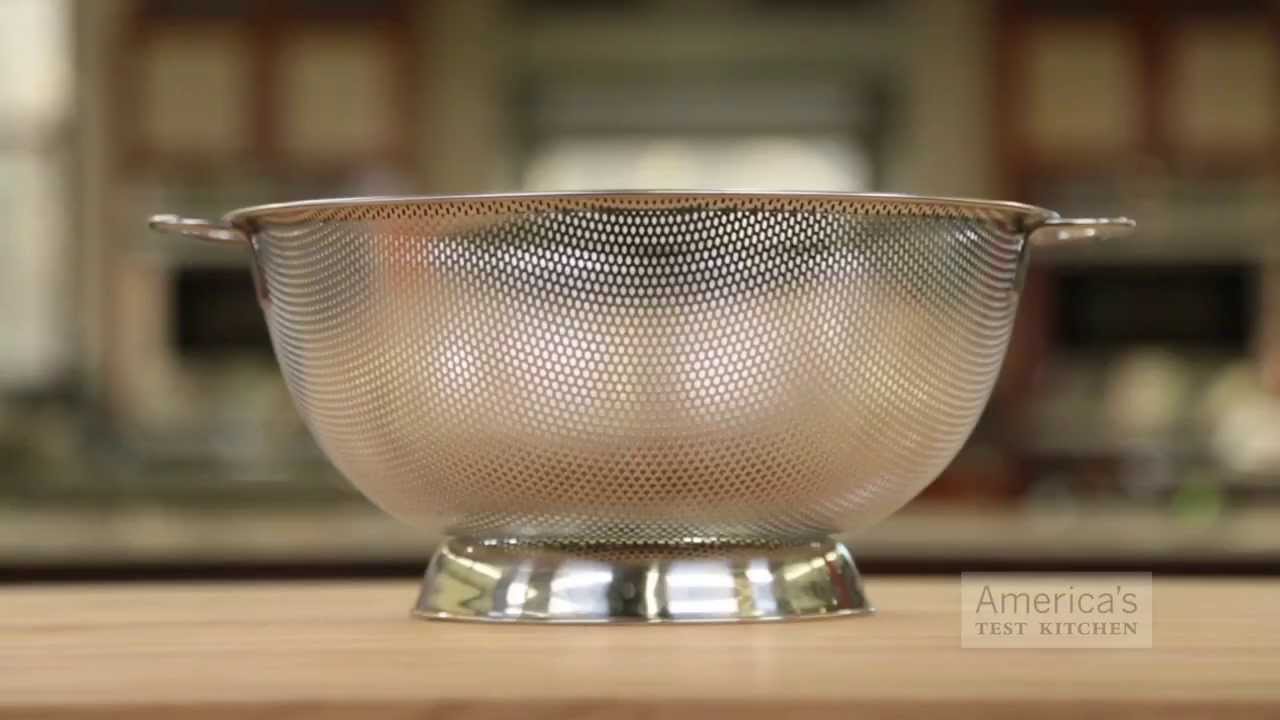
Equipment Review: Best Kitchen Colanders / Pasta Strainers & Our Testing Winner

Buy the winning colander:
Full review and results chart:
A colander is just a bowl with holes, right? Chasing loose pasta around the sink may change your mind about that.
We tested 8 colanders (each roughly 5 quarts) to find the best one:
RSVP International Endurance Precision Pierced 5 Qt. Colander
OXO Good Grips 5-Quart Stainless Steel Colander
Cuisinox 24 Cm Footed Colander
Excel Steel Cook Pro Stainless Steel Mesh Colanders with Silicone Handles, Set of 3
Norpro Krona Stainless Steel 9.5″ Deep Colander
Squish 4-Quart Collapsible Colander
Squish Expanding Over-the-Sink Colander
Reston Lloyd Calypso Basics 5-Quart Colander
We eliminated the following models in pretesting for a variety of design flaws, including flimsy or poor construction, difficulty cleaning, and cramped size: Architec Gripper Colander, Dexas Popware Collapsible 10″ Pop Colander, Joseph Joseph Folding Colander, Norpro Stainless Steel Expanding Over-the-Sink Colander with Base Frame, OXO Good Grips 3-Piece Large Bowl and Colander Set, Progressive International 5-Quart Collapsible Colander, Rösle Collapsible Colander, and Tovolo Stainless Steel Perforated Colander.
Italian chefs on TV dip their tongs into pots of boiling water to retrieve strands of pasta. The rest of us drain our pasta like mere mortals: in a colander. Our favorite has long been a stainless-steel model covered from rim to base in holes that allow water to escape easily. But with many newcomers on the market, we decided that a rematch was in order: our longtime winner versus 15 new colanders, priced from about $18 to $60. Our lineup included larger (roughly 5-quart) colanders made from both stainless and enameled steel and wire mesh, as well as collapsible silicone baskets set in stiff plastic frames. One such model even had extending arms, allowing it to span a sink.
America’s Test Kitchen is a real 2,500 square foot test kitchen located just outside of Boston that is home to more than three dozen full-time cooks and product testers. Our mission is simple: to develop the absolute best recipes for all of your favorite foods. To do this, we test each recipe 30, 40, sometimes as many as 70 times, until we arrive at the combination of ingredients, technique, temperature, cooking time, and equipment that yields the best, most-foolproof recipe.
Each week, the cast of America’s Test Kitchen brings the recipes, testings, and tastings from Cook’s Illustrated magazine to life on our public television series. With more than 2 million viewers per episode, we are the most-watched cooking show on public television.
More than 1.3 million home cooks rely on Cook’s Illustrated and Cook’s Country magazines to provide trusted recipes that work, honest ratings of equipment and supermarket ingredients, and kitchen tips.
Follow us:
Twitter:
Facebook:
source




Straight, to-the-point, no-nonsense, clearly reasoned and rational reviews. Why I love ATK's equipment reviews. Keep up the good work.
Um…. You're doing it wrong. Place colander right side up inside the pot, grab pot, pour water into sink, rinse colander…. Done
LIKE
This is the best video that I ever watch on what makes a good colander.
Thank You!
This kind of content is why we're here!
You seem to be struggling to think of something to say.
Okay, bought this colander. Been 2 years, and a big problem.
It rusts.
The main body is solid. But the bottom stand that's connected to the body, and whatever you wash off on the body remains a bit in between.
You keep straining salty pasta water? Now you get the idea what's gonna happen. It starts to rust. Same thing happens to bottom of the bottom stand. Bottom of the bottom is rolled up, and as you can imagine, things will get stuck in that rolled up part. And it rusts.
Mantap
This is Consumer Reports for those who love cooking. I have bought two products recommended by ATK and guess what? They are more than Amazing – above all I have save money. I will continue buying products recommended by America’s Test Kitchen. You don’t know how much I love you all! A big hug 🤗
Flat bottom can go into a pan.
the first shot of the winner i knew.
"What dafuq is a colander?" – me, who uses a lid to hold the pasta while I drain water into the sink.
The winner is the one Rick Bayless uses in his toasted tomatillo salsa video that I’ve been looking for. Nice accidental find.
would the favorite selected rust or change color
what about a Melamine Colander at Crate and Barrel its $16 or William Sonoma
Zwilling é o melhor!
The expandable silicone collapsable model is great. I've used mine for several years. It was $11
The winning colander looks gorgeous from a design standpoint, too.
Yikes! $25.99 for a colander? I've seen similar colanders as the winner for $6 at the dollar store.
THANK YOU
However, the strainer that was picked also has a solid base so, if it's placed in a sink and the ring covers the drain then water will pool and not drain out the sink. Best find one that is on legs and has tiny holes for proper drainage.
Haiya….
Using colander while cooking egg fried rice, you pak up!
I find that the super cheap $2 mesh colander I picked up from Daiso was far better than any of the premium stuff. Being cheaper actually helps because the lack of material allows me to use it one-handed and there isn't much material to absorb heat and stay stiff, which allows me to grip more than just the rim. It's a waste to buy over-manufactured equipment that is used for holding pasta and vegetables, not as a stepstool.