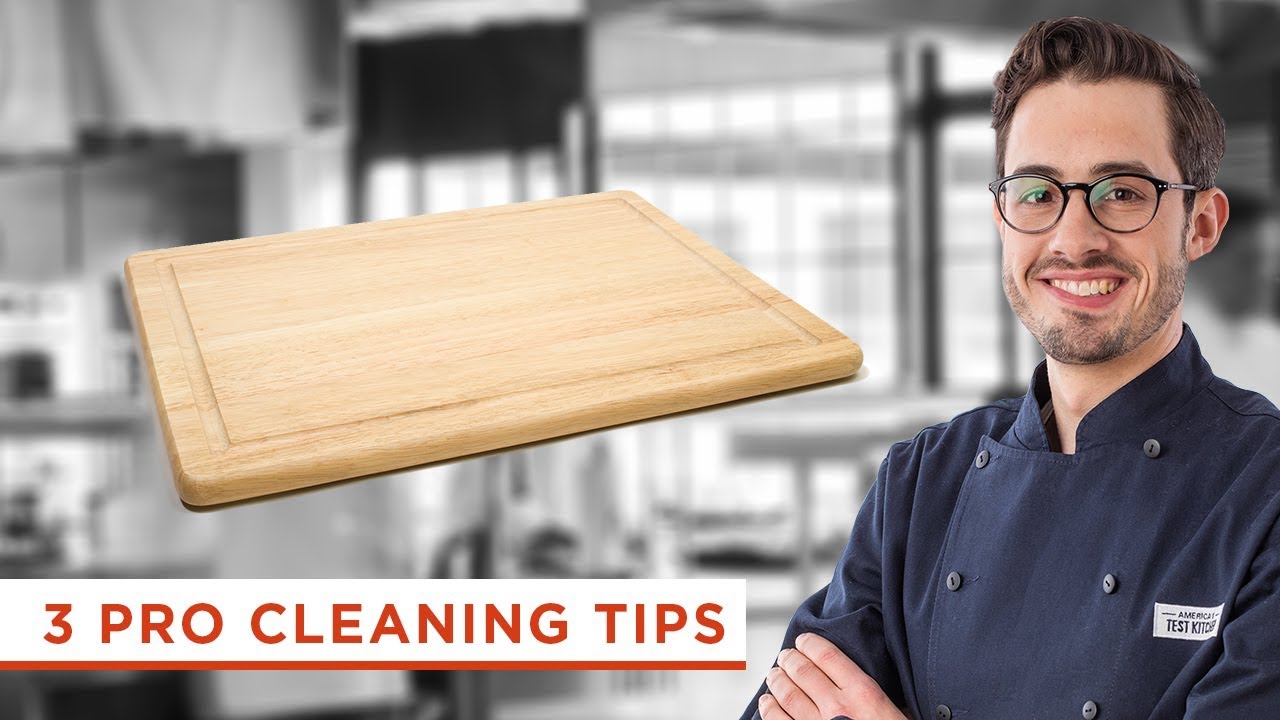
How to Clean and Remove Stains and Smells From Wooden Spoons and Cutting Boards and More Tips

Click here to watch more kitchen tips:
Wooden utensils shouldn’t go in the dishwasher. Fortunately, they don’t need to.
What makes a good serrated knife?
More cleaning tips:
CLEANING WOODEN SPOONS
We love wooden spoons, but because of their tendency to retain odors and transfer flavors, a hint of yesterday’s French onion soup can end up in today’s beurre blanc. Since it isn’t advisable to put wooden utensils in the dishwasher, what’s the best way to remove odors?
To find out, we stood six brand-new wooden spoons in a container of freshly chopped raw onions for 30 minutes, rinsed them with water, then cleaned them with the following substances: dish detergent and water, vinegar and water, bleach and water, a lemon dipped in salt, a tablespoon of baking soda mixed with a teaspoon of water, and more plain water as a control.
The only spoon that our panel of sniffers deemed odor-free was the one scrubbed with baking soda. Here’s why: Odors left behind in the porous surface of a wooden spoon are often caused by weak organic acids. Baking soda neutralizes such acids, eliminating their odor. Furthermore, since baking soda is water soluble, it is drawn into the wood along with the moisture in the paste, thus working its magic as far as the water is able to penetrate.
CUTTING BOARD CLEANING
If you can’t use a dishwasher (which won’t work for wood, bamboo, and some composite boards), is bleaching the next best method for eliminating bacteria from your cutting board?
We sent a stack of boards to a lab, where they were colonized with salmonella, then washed with hot soapy water or sprayed with bleach solution or undiluted vinegar. All methods were equally effective at reducing bacteria to less than 10 CFUs (colony forming units).
We asked an outside lab to compare wood, plastic, bamboo, and composite cutting boards to see if any particular material harbored more bacteria after washing. Bamboo boards actually have antibacterial properties that help kill off bacteria, but all of the materials we tested came back perfectly clean.
BOX GRATER CLEANING
Rubbing a loaf of stale bread is an easy way to clean sticky or greasy residues off your box grater.
ABOUT US: Located in Boston’s Seaport District in the historic Innovation and Design Building, America’s Test Kitchen features 15,000 square feet of kitchen space including multiple photography and video studios. It is the home of Cook’s Illustrated magazine and Cook’s Country magazine and is the workday destination for more than 60 test cooks, editors, and cookware specialists. Our mission is to test recipes over and over again until we understand how and why they work and until we arrive at the best version.
If you like us, follow us:





If you want to do it yourself, just look for Woodprix. There is everything you need to do it 🙂
Baking soda is not alkaline it's basic, as opposed to acidic. Alkaline is a group of metals on the periodic table.
Woodprix has a very large project base.
You'll find all the inspiration you need on Woodprix.
Try the best carpenters and woodworkers plans. Woodglut.
I did it myself. I used Woodglut woodworking plans for this.
Mine works too. I used the Woodprix plans and performed it without any problems.
Bold of you to assume I have stale bread on hand.
I have used this soda and vinegar and 20 different cleaning liquids but my wooden cutting plate sill smells salmon form the 200g salmon that I cut to make sushi 15 days ago!Any suggestion more than welcome 🙂
The baking soda didn't work on taking an egg stain and smell off my wooden cutting board… help 😭
My fear is that soap will get stuck in the pores of the wood..
What about mold on cutting boards . How do you remove this?
It's good to see the woodprix has new instructions to save my money and energy to build it.
I made it too. Just used woodprix instructions for that 🙂
I'm so sure that you can make it too guys. Just look for woodprix.
what about wood boards with oil stains on it.
Or just call a professional to do it for you and save the time and effort i run a business of only cleaning wooden cutting boards our Philosophy is keep the moms happy ( or guys) and creampie the hell out of them after that ( only moms) give us a call at 010 555 6969
Any tip on cleaning a manual sifter? I find the dishwasher or hand washing makes a kind of paste inside the screen.
The energizer bunny of crap is back!
Okay now my cutting board is clean for the night, how do I maintain it? Oh, wait maybe that will the the next 32 – 53 second video. No mention of oiling it?
Oh, and I'm low carb, so no stale bread around. No alternative offered?
nyhyl has it correct, just soak it. And remember to run your sponge opposite direction that you would to grate (seems obvious, but you would not believe the # of people…)
i love dan!!!!!
Wood stove
I’m obsessed with these quick tip videos! Well done ATK; keep em coming!
In the description you say that you sent your cutting boards, made out of a variety of materials, to an outside lab for testing, after washing. That seems like a great topic for another video! I'm sure lots of folks would be interested in the results. The fact that you had the boards tested by an outside lab lends lots of credibility to the results. Thanks for sharing!
Any suggestions for cleaning a box grater for those of us that don't/can't eat wheat or grains?
Old coffee grounds are fantastic for removing garlic & onion odors from cutting boards. Mix with the baking soda paste or a drop of dish soap. Nice abrasive scrub as well.
That last tip with the box grater blew my mind. I don't own a dish washer, and those things are always such a pain to hand wash.
Great tips!
Thanks for great tips
I need a tip to quickly and efficiently remove baked on grease on my stove top without scratching the surface please.
Love