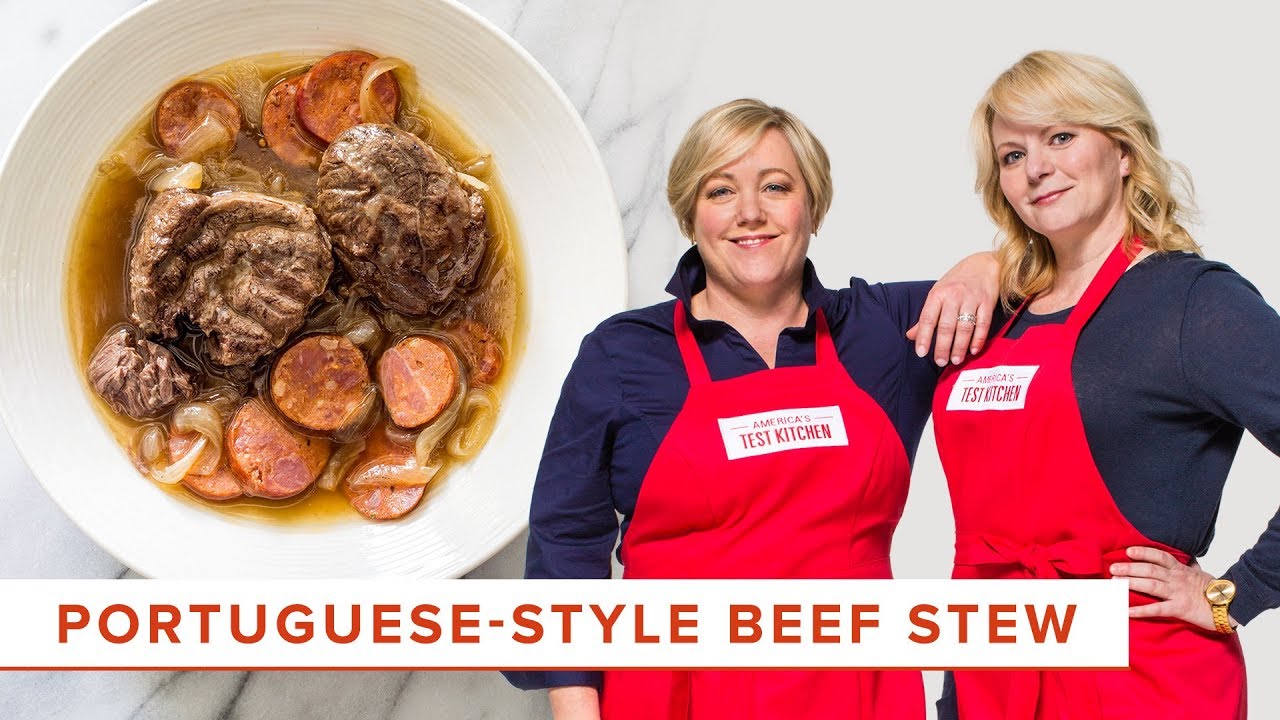
How to Make Alcatra, the Ultimate Portuguese-Style Beef Stew

Host Bridget Lancaster shows host Julia Collin Davison how to make the ultimate Portuguese-Style Beef Stew.
Make Our Portuguese-Style Beef Stew:
Buy Our Winning Dutch Oven:
ABOUT US: Located in Boston’s Seaport District in the historic Innovation and Design Building, America’s Test Kitchen features 15,000 square feet of kitchen space including multiple photography and video studios. It is the home of Cook’s Illustrated magazine and Cook’s Country magazine and is the workday destination for more than 60 test cooks, editors, and cookware specialists. Our mission is to test recipes over and over again until we understand how and why they work and until we arrive at the best version.
If you like us, follow us:


Im trying this tonight – although I don't ever remember my Grandmother making it, she made very similar things and used shanks a lot – especially for soup. It smells like her kitchen, so I'm so excited to try it. The warm spice profile is similar to what she would use. I make her Pork and Clams and her Cocolia also, not as good as hers, but they are good. thank you for another easy Portuguese inspired recipe.
love this receipt!
That is so wrong! But guess everyone has they're interpretation! Never chorizo!!! & clay pot. Very only one region recepy
I'm usually pretty chill about different cultures doing what they can with regional recipes, to make up for what might not be available and unknown techniques, and I'm probably one of the few portuguese that don't have a problem with the infamous pastel de bacalhau + queijo da serra combo. So it's not lightly, or as an easily offended person, that I say this is lazy and disrespectful. I'm not judging the quality of the dish, but the things they changed or took out are exactly what would make this recognizable as portuguese, or even just "portuguese style." Yes: even accounting for the obvious variations that will exist in the way each portuguese cook will make any given typical dish. It's true we typically don't brown the meat, but we brown the onions in "refogado": it's the portuguese version of "sofritto", made with chopped or sliced onions, minced or sliced garlic and bay leaf, and one of the most portuguese things ever. Ask anyone, and they'll tell you how evocative and central it was in their childhood, the smell of refogado as mum started to make dinner. Then you'll throw the meat in. Allspice (as well as "fancier" peppers like rose pepper) only appeared in portuguese supermarkets recently, in this last decade's wave of cooking becoming fashionable); the traditional would be only black or maybe white pepper. The art of portuguese cooking is a lot about just using a few staple (mostly mediterranean-style) ingredients as seasoning (when compared, for example, with the amount of spices used in mexican or oriental cuisines) and still make it as strongly-flavoured and savoury as it gets. Cinnamon is not used in portuguese savoury dishes, period. Keep it for pastries and desserts, where it features heavily and is much loved. Most portuguese stews are known for being heavy on vegetables: at least potatoes and onions, and sometimes peas also, maybe a bit of bell pepper, though that's not as usual. There are also others that are based on chickpeas or beans. Portuguese stews are mainly done in the stove top. Some might have been traditionally made in a wood oven, but the modern everyday substitute is stove, not oven. "Chanfana", a goat stew heavy on red wine where the meat is marinated for days before cooking in the oven, is one of the few exceptions that quickly come to mind. Portugal also has its own kinds of chorizo, called "chouriço". I appreciate that it's probably very hard to find outside of Portugal, and they're similar but decent hosts would have told the public that the typical thing to use would be portuguese chouriço, but that it's okay to use other kinds if you can't get it. (and I really don't personally care about the stupid rivalry that (unrequitedly, I might add) Portugal has against Spain, but oh, the cultural deafness and ignorance of just recommending a Spanish chorizo to a portuguese-styled dish without any acknowledgment… wow.)
Homemade chourico? My uncle used to make it.
This recipe is not a true Alcatra from Terceira Island, however I'm sure this take is delicious as well.
The alcatra is always, always made in a terracotta pot, that is what gives it flavor, its marinated for 24 hours
look forward to making this. but i'll try and get my hands on the Portuguese chourico
Thank you I cooked this last night with chuck and beef shank. I added juniper berries instead of allspice berries and it came out beautiful
This could almost be a Saturday Night Live episode….
looks great, but that spanish chouriço is crap.
👅👅👅
I use gauze instead of cheesecloth because you can find it in any pharmacy without having to search for cheesecloth.
Nice to see but not the regional recipe for Alcatra from the Azorean island of Terceira. Nice try test kitchen. Chouriço or Linguica does not go in this dish.
I made this without chorizo and it was still excellent!
I am going to adapt this recipe for canning.
1. Sear the outside of the beef.
2. Cook the onions in the "beefy" skillet.
3. Deglaze skillet with white wine, and save the liquid.
4. Run liquid through a fat separator.
5. Add whole garlic cloves and dry spices to the sanitized jars.
6. Pack jars 2/3 full with meat and onions.
7. Add 1 tsp canning salt (quart jars).
8. Fill jars with hot wine/onion liquid leaving 1" headspace.
9. Pressure Can for 90 minutes (quart jars).
These ladies can't cook Portuguese food..lol. Portuguese cuisine would use way more allspice (Jamaican pepper) for alcatra and clove is missing in the dish…also they forgot to add any form of hot pepper and we never use a cheese cloth for cooking….the gravy and meat should be much darker and thicker!
All spice berries and cinnamon won't be added traditionally. I will attempt this recipe as it does look delicious.
Because Portuguese Chourico just wouldn't work.
I thought Alcatra meat "piece" in Arabic, not rump or round.
Made this the Second time! Wonderful! I used 3 onions, but did not get very much "Broth" = guess the Suace went into the Onions! Next time I'll hunt for the Long Shank strips ( 1st time Round was dry, this time Chuck &Very Tasty!)
LOOKS SO DELICIOUS SO TASTY GREAT SIMPLE EASY RECIPE THANK YOU APRIL 2 2019
Got most of the Ingredients! (Just need the All Spice Berries) – had to but a 7.5 Qt Oven! SO This IS today's Feast! Can NOT wait to assemble & roast!
THANKS for the Great Recipe & Inspiration!
What's that secret ingredient?? Burnt cheesecloth. Adds that subtle smokey flavor.
How about Portuguese Clams and Pork – Carne de Porco à Alentejana …So good!
This looks delicious. Thanks for these videos
Yikes! – Made my mouth water, just watching! Now off to the Grocery for ingredients!
Azorean Portuguese plz
This show is recorded in New England… a part of The US where there is a very large diverse group of Portuguese people…. myself included…. by the way Azorean food is Portuguese food for those making a distinction. They do have a lot of their own recipes. Just like different parts of the US have different kinds of food. still American food (New England Chowder vs BBQ vs Tex Mex)
That stew is looking great and must be so delicious as well. I was hungry while looking at the video.
Isn't this a repost? I've already seen this on your channel.
IIRC, and I'm sure I may be totally wrong, but I remember that Alcatra is not Portuguese, it's Azorean. Maybe Alcatra is made all over Portugal now, but it came from Terceira Island in the Azores. I was stationed there once, and fell in love with alcatra. Thank you so much for sharing this recipe! I'll be trying it soon!
QUESTION: Is the "allspice berry" the same as whole nutmeg? I have lots of whole nutmeg, but want this dish to turn out correctly, so need to make sure. Anybody? Thanks!
a large tea ball works a lot better then the cheese cloth.
Thank you ATK for yet another doable simple yet, I am sure, delicious dish! I will definitely be making this.
My grandmother made that with silva ling. She would cut the ling. in 2 inch lengths and it would cook the whole way through.
With chicken and rice or potatoes and those pimento olives for a kick. That has always been a staple for me…. Yum Yum…
What? How old is this actual footage? Here I am pining over two beautiful ladies and they're probably not even around anymore frown! Ha ha Ha cheers… Keith
Wouldn't linguica work?