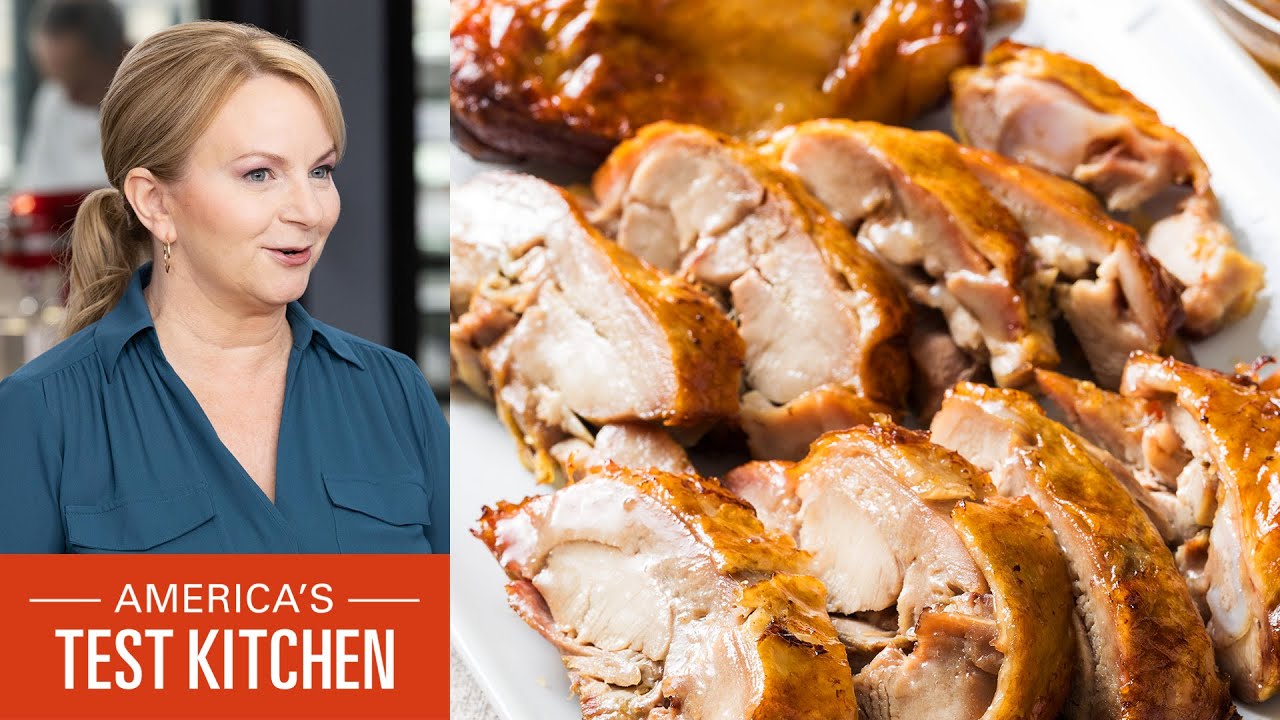
How to Make Turkey Confit with Citrus Mustard Sauce

Host Bridget Lancaster makes host Julia Collin Davison Turkey Thigh Confit with Citrus-Mustard Sauce.
Get our recipe for Turkey Thigh Confit:
Buy our winning food processor:
Buy our winning broiler-safe baking dish:
Buy our winning chefs knife:
Buy our winning Dutch oven:
Buy our winning tongs:
Buy our winning whisk:
Buy our winning baking sheet:
Buy our winning wire rack:
Browse our latest recipes:
ABOUT US: Located in Boston’s Seaport District in the historic Innovation and Design Building, America’s Test Kitchen features 15,000 square feet of kitchen space including multiple photography and video studios. It is the home of Cook’s Illustrated magazine and Cook’s Country magazine and is the workday destination for more than 60 test cooks, editors, and cookware specialists. Our mission is to test recipes over and over again until we understand how and why they work and until we arrive at the best version.
If you like us, follow us:

Could you do that with the whole turkey chopped into sections, thighs, legs, breast, wings, etc.?
Why not place thighs in a sealed bag with duck fat and sous vide ? Less fat needed, and less energy for low temp "pasteurizing."
This sounded great, so we tried it this year for Thanksgiving. I followed everything exactly as in the recipe (except the stems of the thyme–I didn't remember to include them, just the leaves).
The turkey thighs had a great texture. One friend said "This is good. But it doesn't taste like turkey." He was right.
Here's what I learned…
The refrigerator will smell of onions for 5 days. Can this be cured in zipper-lock bags like they do for lots of marinades?
If you don't have 2 ovens, use the cook-ahead instructions. The cooking process monopolizes the oven for at least 6 hours at two temperatures that are unsuitable for anything else (200 degrees and 500 degrees). Major bottleneck (but the roast beets really took off fast at 500).
The first thing I tasted in the first bite was garlic. I'd recommend using less. The overall flavor tasted 'processed'–like the difference between commercial chicken stock and real chicken stock, or like Butterball turkeys and real turkeys. That probably had a lot to do with the salt and onions; it wasn't exactly salty, but the salt was there. Oddly, it didn't taste oniony. But it didn't taste like turkey.
The juices given off during cooking don't get a chance to caramelize, so the gravy was salty, pale, insipid. To be fair, they didn't say to make gravy with it. But just be prepared–you're not going to have gravy. Major bummer.
Browning the skin at 500 degrees set off the smoke detector (without producing visible smoke). Be prepared.
We don't deep fry anything or saute stuff in 1/4" of oil, so this was a change, having to deal with and discard that much fat.
Final problem? No white meat for sandwiches today.
I don't think I'd do this again. It's not worth the effort. The flavor change was a big disappointment, especially the garlic undertones. And I missed the regular turkey. I like turkey, and I don't have any trouble getting it to cook properly.
I might experiment in a few months on one or two thighs without the cure–just to see what the difference could be. I'd like to see if curing is integral to the confit process.
I followed this recipe and your instructions to a tee. Dinner for two. We used 2 turkey thighs. Le Creuset dutch oven. Preheat duck fat to 165F. Thermador oven at 200F – preheated 1 hour. However. After nearly 6 HOURS still not "skewer" tender. So. We just moved on. Removing the bone was a challenge because it wasn't fully rendered. Flavor wise, very good. Sauce – excellent. Be great on rack of pork roast. Sad that your method was that far off on the cook time. Made bringing everything else together timing wise a HUGE challenge.
Could you confit the turkey ahead of time (night before?) and finish in the oven before serving?
I have been doing something similar for a few years but instead of doing it in duck fat in the oven, I have been using sous vide method: 150F for 24h. Then oven to crisp it up. Nothing beats duck fat but… it’s really good.
I love this new idea of preparing turkey. I think I'll steal some of the ideas for the sauce because I think that fresher flavor would be nice with the rest of the Thanksgiving dishes
Q – What do you think?
A – I think I'm hungry.
Q – How many pieces would you like?
A – YES!
LOL, this does look great. I'm getting hungry too.
Did anyone else think that the onion flavor in this was just way too strong?
Any reason not to take the bone out before it goes into the 500 degree oven? Less to fiddle with at the last moment. And I suppose it could be made a day in advance and browned just before serving, right?
Love this technique!! I’m making this !!!
Can this Process be done with a Whole Turkey, maybe Spatchcocked ?
Queens… these two never fail
Just Love cpnfot
We've gotten tired of Turkey every year for Thanksgiving. Last couple of years I've been doing confit of duck. This might be a great way to bring Turkey back to the table.
That just looks soooo good wow !
The onion cure is an interesting twist. I’ve made many batches of confit, but all with dry cures. I will have to give the onions a go.
WOW…I've been salivating while waiting on that turkey to cook. I just know it's got to taste velvety cooked in that duck fat
Can't wait to try this recipe !!!!
Will this work for leg and thigh of the turkey?
I just ordered the stuff I need to make this for Tgiving
This cure sounds excellent. I'll be adapting the confit step to sous vide though. I expect to use way less fat and use the bags for fat separation. I understand that the ATK methods are for traditional home equipment, but I do think more attention should be pointed toward newer and more efficient (and forgiving) methods.
The crumpled foil step shown, but not discussed in the video, is pretty important. This step prevents the fat that will fall from the thighs onto the pan from smoking out your kitchen. The foil adds just enough insulation to prevent the fallen fat from overheating and smoking. Another way to do this is to add thinly sliced potatoes into the pan: Use some of that awesome duck fat to line the bottom of the pan, then add thinly sliced potatoes (like a gratin), then a little oil brushed on top. Salt, pepper, and then proceed with the recipe.
The citrus mostarda sounds pretty killer, so I'll be doing that too.
I don't mean to be negative here, this video was great. Lan is a killer chef.
I can't make that much room in my fridge for four days 😀
Would this recipe work for all parts of the bird?