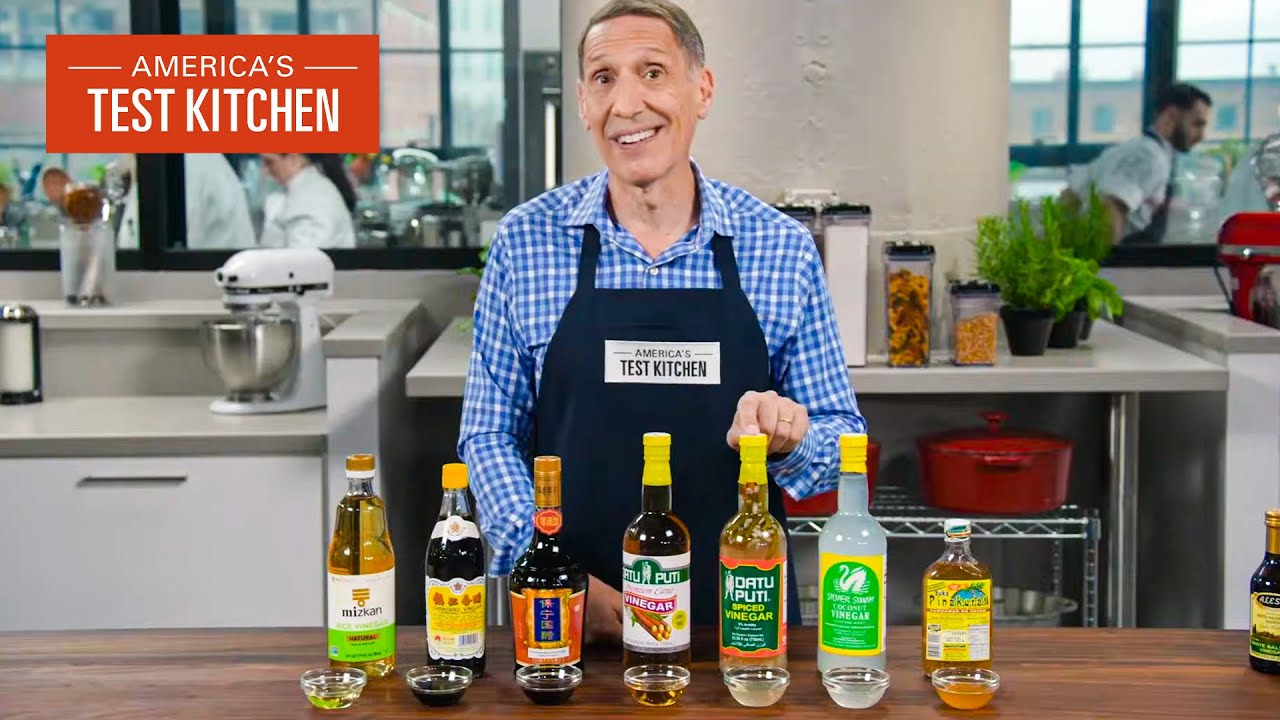
How to Shop for and Use Asian Vinegars | America’s Test Kitchen

The right vinegar adds life and character to the dish it’s used in, and can help enhance the other ingredients. In this episode, our own Jack Bishop explores vinegars used around the Asian continent.
Read our breakdown of vinegars around the world:
Get exclusive access to every recipe, review, and more via our homepage:
Sign up for our free newsletters to receive more delicious recipes, cooking tips, and exclusive content:
Watch full episodes of America’s Test Kitchen and Cook’s Country for free on our new full episodes YouTube channel:
ABOUT US: The mission of America’s Test Kitchen (ATK) is to empower and inspire confidence, community, and creativity in the kitchen. Founded in 1992, the company is the leading multimedia cooking resource serving millions of fans with TV shows (America’s Test Kitchen, Cook’s Country, and America’s Test Kitchen: The Next Generation), magazines (Cook’s Illustrated and Cook’s Country), cookbooks, a podcast (Proof), FAST channels, short-form video series, and the ATK Essential Membership for digital content. Based in a state-of-the-art 15,000-square-foot test kitchen in Boston’s Seaport District, ATK has earned the trust of home cooks and culinary experts alike thanks to its one-of-a-kind processes and best-in-class techniques. Fifty full-time (admittedly very meticulous) test cooks, editors, and product testers spend their days tweaking every variable to find the very best recipes, equipment, ingredients, and techniques.
If you like us, follow us:


Filipino sugar cane vinegar is delicious. Criminally underrated.
Appreciate Jack pronouncing the Tagalog words 👏
For the Philippines' vinegar and non-Tagalog speaking viewers:
"Suka" is Vinegar; "Maasim" is Sour. 1st vinegar Datu Puti Premium is not commonly used for everyday cooking but is a smoother or tone-down version, and is priced a bit higher than the regular. 2nd vinegar is mostly used for dipping. 3rd vinegar from coconut (buko or niyog in Tagalog) and I myself havent tried it. The 4th Suka is famous in central and southern Philippines, whereas "Sawsawan ng Bayan" means Dipping sauce of the country. "Pinakurat" is a cebuano/visayan dialect means Surpise.
There's another Datu Puti (brand) missing in this lineup which is a regular, basic but popular. It' similar to the 2nd but without spices and most commonly used by most Filipinos.
Thank you for this video. =D
Great representation. Keep it up!
Great information but if you don’t use the vinegar on a regular basis, what’s its shelf life once opened?
Forgot Mexican pineapple vinegar. 🍍
Pinakurat is life! If you don't mind a bit of spice, add a bit of it to your adobo recipe. Game changer.
Asian here refers to geography…
ミツカンが出てる😮
Thank you very much for an excellent explanation😊❤❤❤❤
You are so far behind you th8nk you're ahead 😂
This was very informative. I’d also be interested in knowing more about which specific cooking wines to use and how to cook with wine in general…
bro call this the Filipino et al. episode
I learned a lot – Thank you.
What a great video I love Jacks knowledge and genuine respect and love for food and its origins
I ordered something called “black vinegar” online to make hot and sour soup. What I got turned out to be a delightful, well-balanced, seasoned vinegar that I use constantly, but I don’t think is sour enough for the soup. For my second try I bought a highly-rated “black vinegar”, but it has a very strong, weird(?) flavor that I don’t really like. Since they have the same description, any advice on how to find the right one to make soup?
I shop for most of my Asian ingredients on Weee – is there a better option? TIA
Pinakurat is a great dipping sauce. It is commonly on the table for tagay and pulutan (drinks and snacks). It is wonderful on chicharon or lampirong. 😎🍹🌴
Oh no, Jack. You've summoned my people! ☀⭐⭐⭐
I understand that vinegar can last for a long time, but that Pinakurat vinegar recommends consuming before May 2024.
Pinakurat! I love it with everything from roast pork to rotisserie chicken to BBQ meats!
Thank you so much, its so good 👌🏻😊
This is interesting, because I came across a social media Facebook reel for a simple Asian noodle dish, that called for Chinese black vinegar, which I had never heard of before. My wife managed to procure this item for me, and I don't know what to make of it. I have not yet used it in cooking as I have only had it for about a week, but when I taste it on its own, both the aroma, and the taste, have strong notes of Worcestershire sauce. In fact it's almost like unseasoned rice vinegar meets Worcestershire, with a hint of sweetness to it. I wonder where this stuff, that I came by, ranks in terms of the various types of vinegar.
Great info but –heads up: your Suka is expired!
Thanks for featuring our suka! “Pinakurat” literally means “startling” in my native Bisaya dialect. The spiciness of the vinegar startles😂
These are from very different unique cultures, and offensive to bundle together as 'Asian'
It is very valuable to recognize how distinct they are as Jack highlighted at the end.
I really only use Datu Puti. I grew up with it. Same with it's soy sauce. So maybe there are better tasting vinegar and soy sauce in the Philippines but I will never know. Being in the US for so long now I just buy the same thing every time.
Would love to see you showcasing dishes with those vinegars, especially the Filipino ones.
Black vinegar is great with potstickers (aka gyoza or guotie)
I always have black vinegar and sushi vinegar on hand but now I want to try some vinegars from the Philippines.
I learned a lot! THANKS for your video!👍Much appreciated ❤❤❤
Thank you!
No palm vinegar? An essential for adobo according to a Phillipine friend.
Seriously… how much cupboard and fridge space do people have? I would love to have all these, but one will have to do.