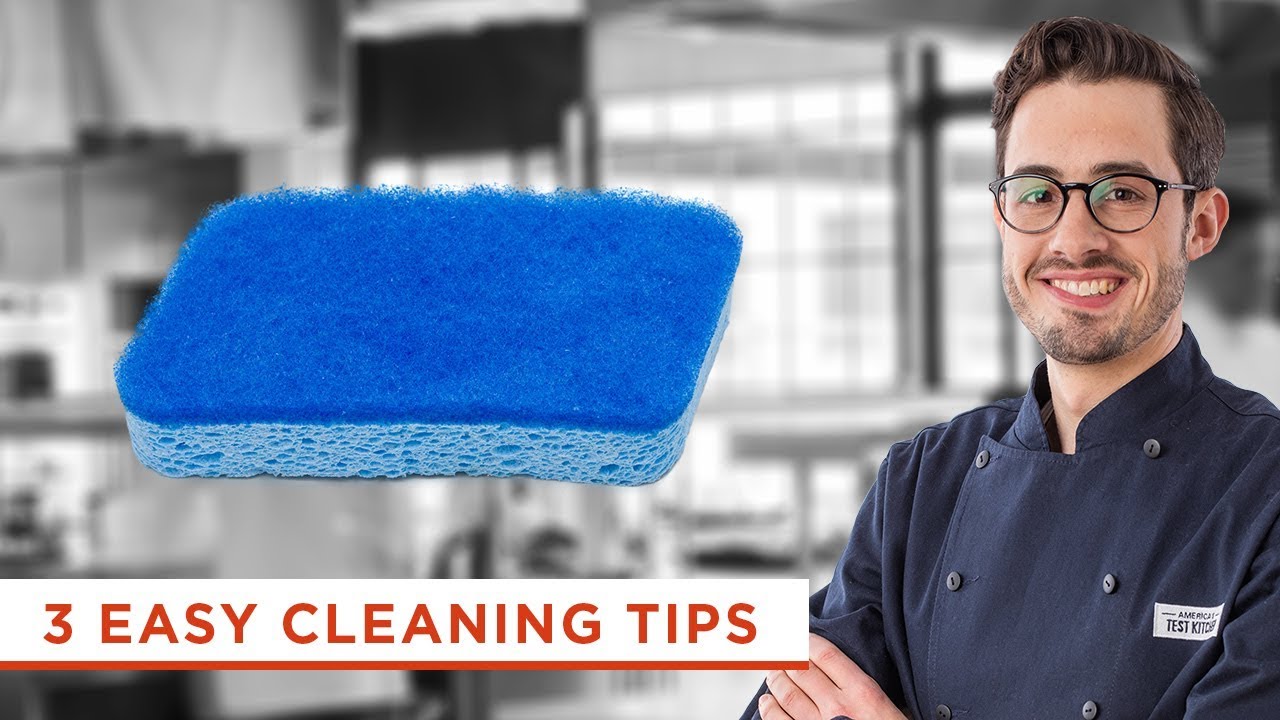
Keep Your Kitchen Clean & Safe: The Best Way to Disinfect Your Sink, Sponge, & Garbage Disposal

Click here to watch more kitchen tips:
Some of the most effective ways to cut down on harmful bacteria in the kitchen aren’t what you’d think. Depending on factors such as moisture, temperature, surface porosity, and the particular strain of bacteria, microbes can live as long as 60 hours on your sink or cutting board. But you don’t need anything special to clean a kitchen—for the most part, we rely on old-fashioned soap and hot water or a bleach solution.
We review the best (and worst) saucepans:
Here’s how to defrost meat quickly and safely:
All Hands Under Water
Washing your hands is one of the best ways to stop the spread of food-borne pathogens. Wash before and during cooking, especially after touching raw meat and poultry. The U.S. Food and Drug Administration (FDA) recommends at least 20 seconds in hot, soapy water. How long is that? Try singing “Happy Birthday.”
Sanitize your sink
Studies have found that the kitchen sink is crawling with even more bacteria than the garbage bin (the drain alone typically harbors 18,000 bacteria per square inch). The faucet handle, which can reintroduce bacteria to your hands after you’ve washed them, is a close second.
Water plus Bleach
Though we’ve found that hot soapy water is amazingly effective at eliminating bacteria, for added insurance, clean these areas frequently with a solution of 1 tablespoon bleach per quart of water (the bleach will also kill off some of those microbes in the drain).
Cleaning Sponges
Whenever possible, use a paper towel or a clean dishcloth instead to wipe up. If you do use a sponge, disinfect it. To find the best method, we tried microwaving, freezing, bleaching, and boiling sponges that had seen a hard month of use in the test kitchen, as well as running them through the dishwasher and simply washing them in soap and water. Lab results showed that microwaving and boiling were most effective, but sponges can burn in a high-powered microwave, so we recommend boiling them for 5 minutes.
ABOUT US: Located in Boston’s Seaport District in the historic Innovation and Design Building, America’s Test Kitchen features 15,000 square feet of kitchen space including multiple photography and video studios. It is the home of Cook’s Illustrated magazine and Cook’s Country magazine and is the workday destination for more than 60 test cooks, editors, and cookware specialists. Our mission is to test recipes over and over again until we understand how and why they work and until we arrive at the best version.
If you like us, follow us:

"Boiling sponges is the best method", good to know. Thanks. This video was right to the point.
Also, you can freeze a 50/50 mix of white vinegar and lemon juice in ice cube trays and use them as garbage disposal cleaning pods.
✌️&❤
For one the science is never settled. Dishwasher , microwave sponge full of water for 2 mins, then boil for 10 minutes. (Think canning… you don’t have to sterilize your jars if you’re processing time is 10 minutes or over) Then throw away 😆 😉
Put Your sponge into microwave. Microwaves have anti-microbial properties… Though use only program for frozen foods in order to not melt Your sponge 😀
Thank you for this video.
Better yet, don't use sponges. Use brushes that go into the dishwasher after use, and microfiber cleaning towels that are washed after each use. I use commercial microfiber towels that can be washed at sanitary temps and also safely bleached.
The best way to clean the kitchen cloth is to use a teaspoon of washing powder and warm water. While the suds are on the cloth use it to wipe out the sink and surround. Then just rinse and keep wiping and then you have a clean sink and cloth. Usually every second or third day depending on your usage
Can you do an equipment review on pasta makers?
How often do you boil your sponge for 5 minuets?
What is a spent lemon?
There is a really good scientific article i couldn't find right now, that tested all the possible disinfecting ways for sponges and they said that disinfecting sponges are the WORST thing you can do! it kills most of the bacterias but the resisting one are the most pathogenic bacteria and after disinfected they can grow easily! They suggest that is impossible to disinfect completely because this type of bacteria can easily do a "biofilm" inside the sponges that prevent them to be killed. You have to change sponges once in a week at least
Any evidence on the bacteria in these places causing harm? Or is it like the bacteria in mud that really don't do much?
You're a sexy beast, Dan. Sighhh.
memo… boiling,, is the best…
The science has spoken, replacing your sponge every week not sterilizing it, is the best method. Sterilizing your sponge mostly kills off the weak bacteria leaving the harmful bacteria less competition and more space to grow.
ATK NOW INTRODUCING::TRASH CAN TUTURIALS &… Common ;). Bridget Lancaster & Lisa McManus you are the best. -top notch hosts. The rest of the hosts are amazing too, one by one. You helped me a lot over the years to make wise decisions and through your input I've purchased my Vitamix Pro 750, Kitchenaid mixer, Tramontina Tri Ply cookware, Thermapen and much more! all are in great shape an work wonderfully! (lisa and Bridget I give you the "You make me Happy Award" for every time I watch another video with you, it just make me so happy. your the best. )
Put your sponge in the dishwasher. Don't put peels in your garbage disposal. Just run it with some ice cubes and water for 30 seconds.
Thank you! What about wood chopping boards? I have tried lemon juice + salt, baking soda + white vinegar, dishsoap – nothing seems to completely get the smell out of my board (it is not a major problem but if I put my nose up to it one side definitely does not smell like the other; fresh wood smell). Am I simply being unrealistic in my expectations?
Do a video on how to keep oil from splashing everywhere and making everything greasy when frying stuff
Can I make sponge soup?
Thanks for the tips.
3 Easy signs you may have a stroke…..
Has he always done that with his mouth or did something happen to him?
Umm no but maybe the lemon in the grinder if you like lemons, I'd suggest ice cubes, salt and your choice of disinfectant including the occasional boiling water. Otherwise, if you have a non-metallic sponge .. wash but keep moist and microwave for 2 minutes. Next, use Pine Sol or Lysol and Detergents to clean its not corrosive or as damaging as bleach.
Sponge https://www.webmd.com/food-recipes/food-poisoning/news/20070124/microwave-kills-germs-sponges
Pine Sol or Lysol vs Bleach http://allnurses.com/health-stress-management/home-disinfectant-of-442466.html
yes yes but the question is why would I want to do that ?
18,000 bacteria per square inch, as opposed to what? What's the normal amount?
A nice straight forward video! Only minor complaint I have: I understand this involves spending time but it would be nice if you elaborated more on what else you tried and why it didn't work because right now it's hard to tell exactly why I should trust you on certain issues
On the other hand I recommend not to surround yourself by sterile environment on every step or you can seriously hurt yourself in the long run. Some bacteria exposure in daily life is a good thing and it empowers your immune system.
How often to boil the sponge though? I prefer to buy cheap sponges and change them frequently (they don't last long anyway).
Ah, very good! I saw you on that astrologer Doctor Oz. That dude always ciphens the underground content. He's like a gate keeper. Daniel 4:7 Then came in the magicians, the astrologers, the Chaldeans, and the soothsayers: and I told the dream before them; but they did not make known unto me the interpretation thereof.
Brilliant straight forward and easy information.
What's the best way to clean greasy glass stovetop and range hood?
I was taught to sanitize sponges by running them through a cycle in the top rack of the dishwasher. Did ATK test that, and if so what were the results?