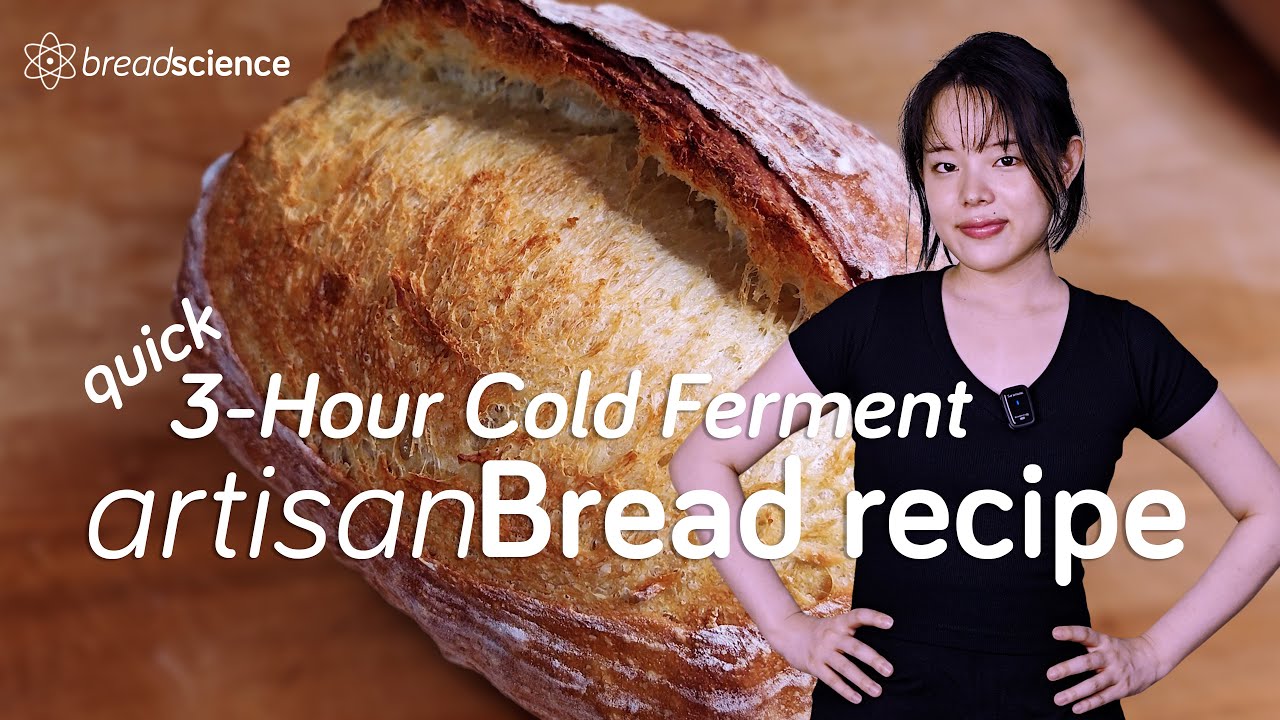
Quick 3-Hour Cold Fermented Artisan Bread Recipe | with Tangzhong and Poolish

In this video, we’re making a beautiful and delicious artisan bread with a 3-hour cold ferment. This bread is absolutely fantastic: it’s airy, soft, and crispy on the outside. This is the shortest cold fermentation recipe you’ve ever seen, and we’ll give you everything you need to know to make this delightful bread. We’ll also cover common misconceptions about short cold fermentation and provide a practical guide for home bakers. Watch the video for more!
#artisanbread #tangzhong #yudane #poolish
Ingredients Weight %
Bread Flour 400 100%
Total Hydration 286 72%
Tangzhong
Bread Flour 60 15%
Boiling Water 120 30%
Poolish
Bread Flour 80 20%
Water 80 20%
Instant Yeast 0.8 0.20%
Final Dough
Bread Flour 260 65%
Water 86 22%
Instant Yeast 3.2 0.80%
Salt 7 1.75%
All of the Poolish
All of the Tangzhong
Total Dough 697
References
1* Birch, Anja N., et al. “Influence of commercial baker’s yeasts on bread aroma profiles.” Food Research International 52.1 (2013): 160-166.
2* Baardseth, P., et al. “The effects of bread making process and wheat quality on French baguettes.” Journal of cereal science 32.1 (2000): 73-87.
3* Birch, Anja N., Mikael A. Petersen, and Åse S. Hansen. “The aroma profile of wheat bread crumb influenced by yeast concentration and fermentation temperature.” LWT-Food Science and Technology 50.2 (2013): 480-488.
4* Li, Junkui, et al. “Variation in quality of noodles by regulating the dynamic transition behavior of gluten proteins though dough crumbles temperature control method at different stages of mixing.” Food Research International 208 (2025): 116209.
source
There was a typo at 18:34. It should read '…after one hour.' Blurred out.
What would be the amount of sourdough in lieu of the poolish/ yeast?
great work, tnx!
🤎👍🩸👍
I really appreciate and enjoy your channel. Thank you very much for helping me understand why and how.
I applied this recipe for my sourdough starter. I’m making 250g of flour in final dough (for experimenting), used 1:2:2 ratio, from my starter. Applied directly the flour and water of poolish % to gauge my starter yeast, resulting 25:50:50grams to activate all yeast I need for this bread. (I know it’s not exact as yours)
My starter got to the peak after about 6-7 hours. Then I followed the rest of the procedure (I already made Tangzhong in fridge before making the dough).
I used icy cool water. I think my dough was all the way cold… I didn’t see much bubbles like my yeast was sleeping until baking in oven. Oven spring achieved, the bread is tender, springy, gummy, but much less bubble holes good for a sandwich bread. Tastes great too.
I am concerned about cold and not bubbly dough. Does it mean my fermentation isn’t at its best when I baked it? 🤔 Thank you!
Just discovered the channel. Impressive quality of videos 👏
My bread didn't move at all even after the 2 hours. After the 30mins it was stiff as hell to the point where trying to do a stretch and fold just lifted it out of the bowl, and after 2h it was the same size. I don't get this one, I don't know how a loaf can rise after 2h in 5c
Your room temp of 27-29c is for lack of a better word, bonkers. Just pure insanity. I would DIE in that heat lol. Do you have a rec for say, 20c ? My kitchen is that at its warmest unless I'm cooking.
Amazing. You’re challenging and empowering everyone from the home baker to the corner bakery owner to up their bread game. Communication is all – you’re the Neil Degrasse Tyson of bread!
Would adding the salt to the hot water when making the tangzhong be okay?
Gracias Linda ,muy Bien explicado ,por ti estoy aprendiendo mucho .
I never even considered, that yeast itself could be a quality product.
This channel i have been looking for for a long time!♥️
I started using cold fermentation out of necessity , I let the dough between 12 and 24hrs in the fridge, because of how little time I had every day. One day I did have enough time and made my bagels in one day using room temperature fermentation and the flavor profile is totally different. I now prefer to use cold fermentation for the more complex flavors
I’ve been baking sourdough since 2020 like everyone else. I love the fresh ideas here, and you do a wonderful job of explaining each step in detail.
a beginner here🙋♀ thank you for all these great videos and that recipe in particular! your channel is a wonder
Thanks for this, if I use a sourdough starter, I assume the cold fermentation time will be longer? Would you be able to give some advice?
Welcome back Novita!!! Thx a lot for this new bread lesson….. ciao
Thanks for the awesome video!
Have got a one question.
The same ratio of dough could be used for pizza?
Have never used tangzhong for pizza. So just curious that it is proper for the pizza dough.
And it seems that the result is for hard bread dough.
Could you make a video for soft bread dough as well?
By the way, there is a typo on 18:35, it should be 1 hour later rather then after 30 minutes! Just noted!
do y'all still use ai generated images? i rather just look at seraphine talk than something that takes mass amounts of pollution to create.. or u can just put cats or something idc
Sounds like we’d lose enzyme phase of the Tangzhong? Maybe Tangzhong should be prepped ahead to get that benefit or is there any tradeoff?