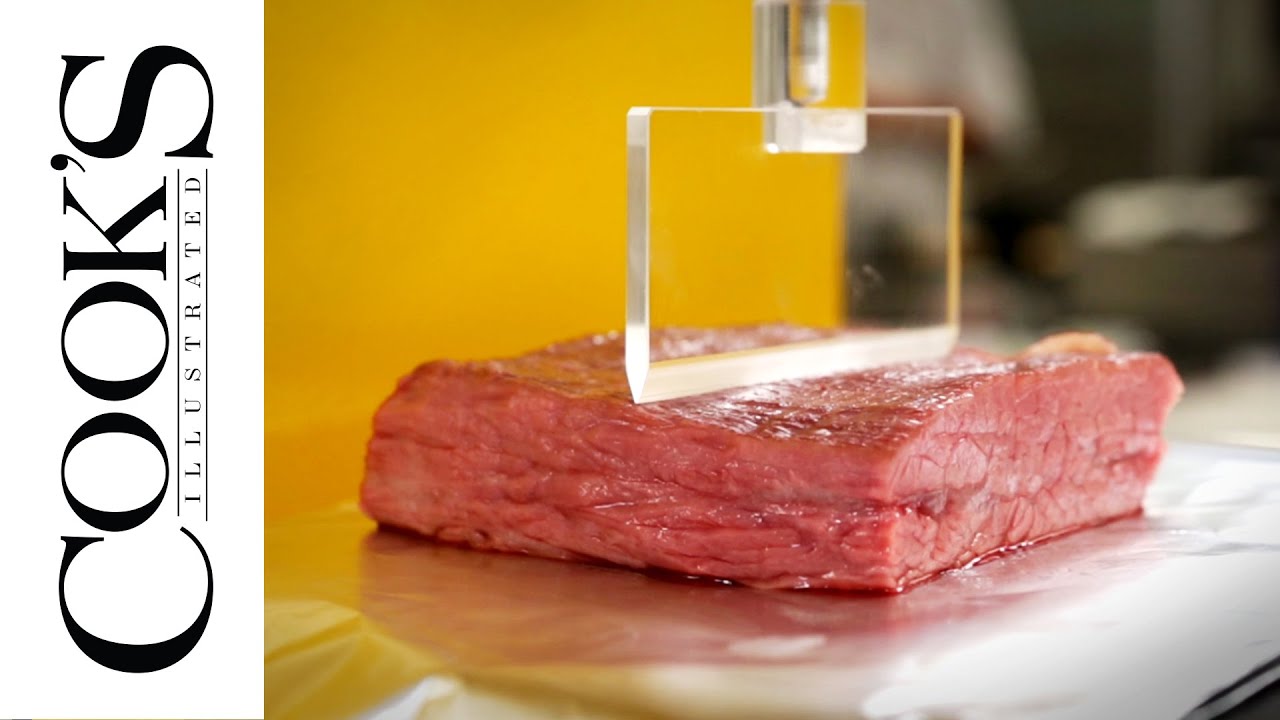
Science: How to Slice Steak and Make Cheap Beef Cuts (like Flank Steak) Tender with Only Your Knife

Buy Cook’s Science today:
The Science of Good Cooking:
Do you know how to slice steak or how to cut meat? The way you cut steak can make all the difference. Here’s why it’s important to learn about slicing meat.
Cook’s Illustrated recipe for Pan-Seared Flank Steak with Sriracha-Lime Butter:
Here’s the best way to reheat steaks. Watch now:
You’ll love this tip on how to quickly defrost meat. Watch now:
We know that it’s possible to make relatively tough cuts like flank steak more tender by thinly slicing them against the grain—that is, perpendicular to the orientation of the muscle fibers—rather than with the grain. But how much more tender? We decided to quantify just how much difference using the correct slicing method can make.
EXPERIMENT
We cooked a whole flank steak in a temperature-controlled water bath to 130 degrees, cut equally thick slices both with and against the grain, and used an ultrasensitive piece of equipment called a CT3 Texture Analyzer from Brookfield Engineering to test how much force was required to “bite” into the slices. We repeated the experiment three times and averaged the results. We also duplicated the tests with a more tender piece of strip loin.
RESULTS
Flank steak slices carved against the grain required 383 grams of force to “bite” 5 millimeters into the meat, while slices carved with the grain required a whopping 1,729 grams of force—more than four times as much—to travel the same distance. Strip loin slices carved against the grain required 329 grams of force; with the grain, 590 grams of force.
EXPLANATION
Flank steak contains wide muscle fibers and a relatively high proportion of connective tissue that make it chewy. Slicing it against the grain shortens those muscle fibers, making it easier to chew.
TAKEAWAY
What’s the best way to slice meat? Slicing against the grain dramatically narrowed the gap in tenderness between the strip and flank steaks. Flank steak sliced with the grain was 193 percent tougher than strip steak sliced with the grain, but that difference dropped to just 16 percent when both types of steak were sliced against the grain. So while all cuts benefit from slicing against the grain, it’s especially important when slicing flank steak. In fact, slicing a flank steak properly can make it tender enough to rival premium steaks.
ABOUT US: Located in Boston’s Seaport District in the historic Innovation and Design Building, America’s Test Kitchen features 15,000 square feet of kitchen space including multiple photography and video studios. It is the home of Cook’s Illustrated magazine and Cook’s Country magazine and is the workday destination for more than 60 test cooks, editors, and cookware specialists. Our mission is to test recipes over and over again until we understand how and why they work and until we arrive at the best version.
Each week, the cast of America’s Test Kitchen brings the recipes, testings, and tastings from Cook’s Illustrated magazine to life on our public television series. With more than 2 million viewers per episode, we are the most-watched cooking show on public television.
More than 1.3 million home cooks rely on Cook’s Illustrated and Cook’s Country magazines to provide trusted recipes that work, honest ratings of equipment and supermarket ingredients, and kitchen tips.
If you like us, follow us:




Do you still cut against the grain when sectioning off a large piece of raw steak into smaller pieces for ease of cooking?
I ate sirlion steak 2 days ago and my jaw muscles still hurt and that's why I'm here.
Sorry, but since the advent of "food/cooking" shows…..cheap cuts no longer are 🙁
I so enjoyed your explanation, now I will never forget to cut my steaks against the grain! #sciencemajor
Thank you!
Watching this in 2020 and Dan looks so young
Mislabeled video It does not show you how to slice steak it just talks about it
WRONG. With and against shots are correct, audibly, and wrong visually.Bad Science-ing
This test is not a good one, you tested the bite with and across the grain direction, not actually against (first test should be tried on the end were we see a fibre ends), also, if you cut a steak with the grain you can cut bitesize pieces from it against the grain
PLEASE DO THIS WITH COOKED STEAK. my stepmom wants me to cook a filet mignon well done and I refuse to ruin a steak like that.
So wait i'm confused. There's much less force required to cut against the grain rather then with the grain. So wouldn't you want to take into account how the person is eating the beef with their teeth, rather then how you actually cut the meat? For me I feel like how I would chew the meat would actually be opposite to how cut the meat. Anyone agree?
Cheap Beef Cuts (like Flank Steak)? Not at $12+ a lb. I can now get a pretty good cut of steak for much less!
I love beef!
Give me a knife, a salt shaker and point me towards a steer? And he's in serious trouble.
Cooking NOT necessary!
Not even kidding either.
I don't always eat it raw, but a good tenderloin you can pull apart with your fingers? Why not! Yum!
Bite machine? What the ****. Lol. Are you kidding me?
Why doesn't this work with my pork? You can cut it anyway u want, tuff pig is still tuff pig, got a Blender??
In what world is flank steak cheap?
Too much advertisement and many videos on youtube basically destroy the market. Like trip advisor and instagram do to the treasures of each country! People learn about food, and locations and the result is that we pay inflated prices. Flank it should be dirt cheap. not rivaling fucking rump
Always cut against the grain! One negative thing about flank steak is increasing cost. 10 years ago I could get a 3 or 4 pound steak for about 8 bucks, but for some reason now that same steak costs almost twice as much these days, I'm paying 15 to 20 for that same size now. Might as well just get two porterhouses for the same price. I don't know If its just my area or what, but the cheaper cuts like flank are almost priced like premium steak these days
@1:25 how is that against the grain??
I believe you’ve proved that it doesn’t matter which way you slice the meat but it’s best eaten against the grain. Practice that muscle memory lol.
Flank's not that much cheaper nowadays, at least where I live.
You say "against" the grain but "ACROSS" the grain is much more explicit terminology and is much easier to understand.
Where does the idea come from that flank steak is a "cheap cut"?
In my local groceries it goes for anywhere from $9.99 to $11.99 per pound?
That's "cheap"? Sirloin is only $6.99-$7.99 and New York Strip is only a buck more per pound than flank — and sometime on sale for less.
Flank steak is an /expensive/ cut of meat!