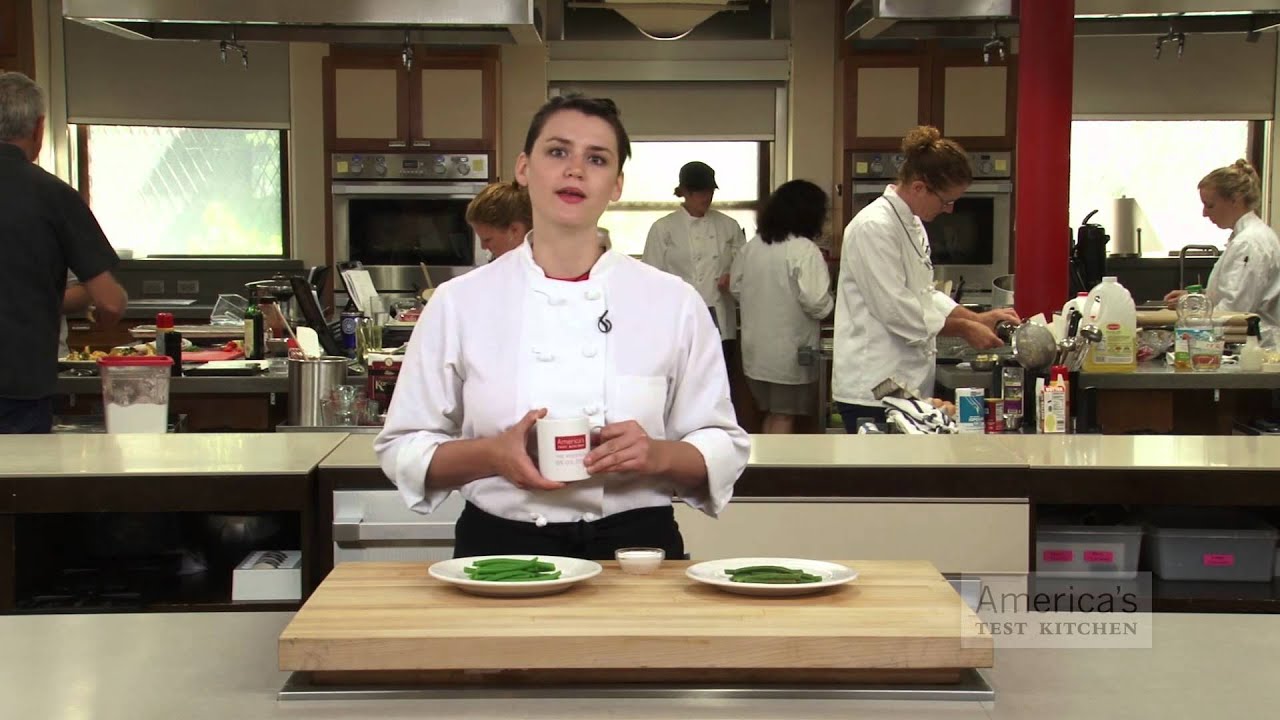
Super Quick Video Tips: 3 Great Uses for Salt (Besides Making Stuff Salty)

A slew of hidden talents prove this ingredient is certainly worth its salt in the kitchen. See how salt can save the day—including retaining the brilliant color on boiled green vegetables, tempering the bitterness of coffee, and keeping your scrambled eggs and omelets tender.
Watch more Super Quick Video Tips at
America’s Test Kitchen is a real 2,500 square foot test kitchen located just outside of Boston that is home to more than three dozen full-time cooks and product testers. Our mission is simple: to develop the absolute best recipes for all of your favorite foods. To do this, we test each recipe 30, 40, sometimes as many as 70 times, until we arrive at the combination of ingredients, technique, temperature, cooking time, and equipment that yields the best, most-foolproof recipe.
Each week, the cast of America’s Test Kitchen brings the recipes, testings, and tastings from Cook’s Illustrated magazine to life on our public television series. With more than 2 million viewers per episode, we are the most-watched cooking show on public television.
More than 1.3 million home cooks rely on Cook’s Illustrated and Cook’s Country magazines to provide trusted recipes that work, honest ratings of equipment and supermarket ingredients, and kitchen tips.
Follow us:
Twitter:
Facebook:
source




A little salt on watermelon will make it taste sweeter.
Wrong on the vegetable coloring and salting eggs before cooking..
Someone needs to send her a copy of Harold McGee's "On Food and Cooking" for a real science lesson.
How the hell do you manage to make scrambled eggs go tough…
she s cute !!
And you expect it not to be scripted? She's new. Give her a break. Unless you've been in front of a camera doing this sort of thing for years, you would be just the same.
Their claim about salts effect on chlorophyll is anything but conclusive. They are really jumping the gun on that one. It is just as likely, or even more likely that salt is helping soften the vegetable, making it cook faster, which in turn lessens the damage of the chlorophyll. Furthermore, the amount of salt they use is likely too low to shift osmotic pressure like they claim. Actually they are further incorrect by claiming that the chlorophyll leaks out, which is not true. It gets damaged.
You can read all about it on definitivecooking.blogspot.com
Kosher salt has a larger less refined (more natural) crystalline structure and usually has no additives, table salt often includes iodine and is milled to produce a finer, more consistent texture, sea salt is taken from the sea and often includes many flavorful chemicals and are also a larger more natural crystal.
the difference between most TV chefs and America's test kitchen is that the TV chefs will spout common wisdom that they learned in a book or a class while the test kitchen will make hundreds of omelets with salt added both before and after cooking and run them all by dozens of taste testers both pros and laymen to find out the truth. sometimes their test upholds the common wisdom, sometimes it doesn't.
David Rosengarten (TASTE) also has said adding salt to eggs before cooking will toughen a french omelete. Salt them after cooking.
But, if two camps are saying contradictory things and there is no clear answer, that tells me the answer probably doesn't matter, because the difference is too hard to discern.
It's best to listen to the test kitchen since they perform and are backed up by science, over some TV sell out of a chef who believes adding hydrophobic oil to boiling water will infuse flavor into the boiling product….
You need to have this girl do a LOT more of these segments.
I like my coffee taste bitter.
Now what is the difference between kosher salt,table salt and other types of salt!?
Gordon Ramsey says not to salt eggs before cooking. He says it breaks down the eggs and causes them to become watery.
I can't wait to try the scrambled eggs tip. Thanks
Have you found that your coffee has turned sour? Add a pinch of salt. Doing that takes away the sour in the coffee.
Adding salt to my coffee grounds sounds interesting so I'll try it out. I've seen high end chocolate shops put sea salt on top of their chocolate for a unique taste.
will definately be adding salt to my eggs. thanks