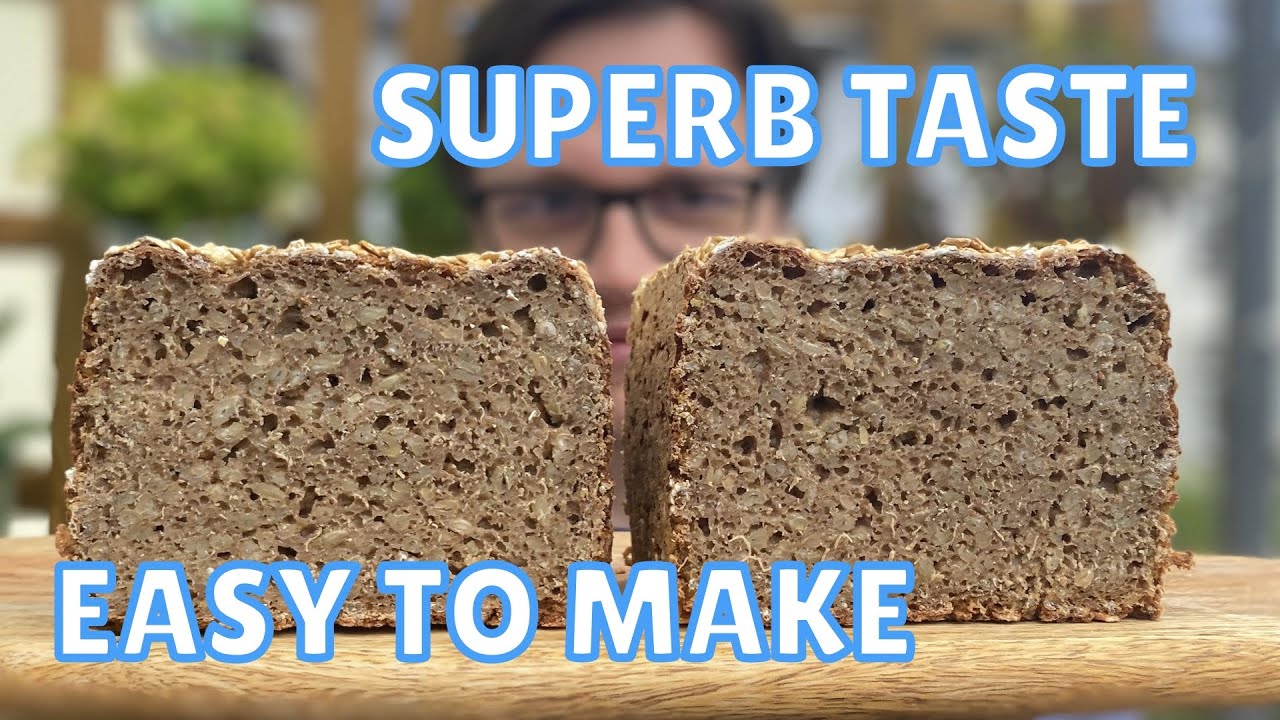
THE BEST SCHWARZBROT RECIPE – 100% AUTHENTIC GERMAN BREAD

This is how you make an authentic and amazing German Bread: Schwarzbrot. Using this recipe you will master making this superb tasting bread. This is the bread we Germans love and it features amazing taste and an excellent crust.
First of all – sorry international audience and hello Nordics and Germans. To the outside world this seems like a crime against bread craftsmanship, but to us this one of the best breads that we enjoy. We typically eat a lot rye flour and this bread consists of exactly that, rye flour and even more rye seeds. That’s what “Korn an Korn” translates to, seed to seed. “Schwarzbrot” translated to “Black bread”, because of the black color. The color is coming from both the rye flour and typically a little bit of molasses or malt that is being added.
I love to bake this recipe since I can use a lot of discard starter that I have at hand. Plus – it is probably one of the easiest to make breads that I could think of. No kneading, mostly just stirring the ingredients.
Ingredients:
– 400 grams sourdough starter (can be discard)
– 400 gram of rye seeds
– 200 grams of rye flour
– 200 grams of water
– 8 grams of salt
Instructions:
1. Mix together all the ingredients
2. Stir until they are homogenised
3. Place in a covered pot, wait until doubled in size
4. Spray/coat your loaf pan in olive oil
5. Add oats and spread them across the loaf pan
6. Toss in the dough, spread it out
7. Cover the loaf pan
8. Wait at least 2 hours until you see the dough rose/increased in size. You could bake it now, or…
9. Take the dough and place it for another 8 hours in the fridge
10. Preheat the oven to 230°C
11. Place the loaf inside, cover with tin foil, or have a loaf pan with a cover
12. After around 30 minutes remove the tin/cover
13. Bake until temperature in the center of the loaf is 95°C. Took me an hour to get there
Flour I am using:
Blog article on different flours in Germany:
Drax Mühle Manitoba flour 14% protein:
For ze Germans – T550 at Rewe 11-12% protein:
Mulino Padano 15% protein:
Follow me here too:
Github:
Instagram:
My blog:
My website:
Reddit:
Telegram:
Tiktok:
Hoodies/T-Shirts:
The bread themed T-Shirts/Hoodies I designed and wear:
Tools:
Banneton proofing basket (25cm length, 15cm width, 8.5cm height):
Cooling rack:
Dough scraper:
Dutch oven for batards (Challenger Bread Pan):
Dutch oven round (Lodge):
Dutch oven with glas lid (Brovn):
Infrared thermometer:
Loaf pan (30cm length x 12cm width x 9cm height):
Loaf pan with lid (34cm length, 13cm width, 12cm height):
No stick spray (vegetable based):
pH meter to check acidity:
Weck starter jars:
Useful videos:
Debaked ep. 1 – Pizza journey to Napoli:
Debaked ep. 2 – Journey to a flour mill:
Discard starter bread:
Fermentation time table:
Make your starter more active:
Recommend sourdough bread recipe:
Sourdough starter:
Chapters:
0:00 Intro
1:30 Making the dough
4:18 Shaping the dough
6:00 Baking the bread
#germanbread #schwarzbrot
source


Made this today. What a cool way to use up all of that discard. I really liked it but next time I will cut back on the molasses a bit, but overall very nice :).
Hi great vid. I was wondering what you put on top of the bread. Do Germans spread butter on top? When they eat it for breakfast
Thanks matt
Was sind denn rye seeds? Is it the same as grains?
I made the all dark rye. My first time. Baked it last night.
I'll know next time to do the overnight refrigerator proof. I added cracked rye kernels and sunflower seeds. I wanted them softer so I soaked it all overnight them in water overnight. And try with molasses. I added barley malt syrup this time.
I have to say. This is so delicious! My husband said he likes it even better than the sourdough I normally bake with bread flower and 20% of a rye and Spelt mix. And it's so much easier to make! Thank you @thebreadcode !
I think we'll have it again tonight with some lox and tomato slices. (Mine with non dairy cream cheese. Yum!)
I made the starter using your recipe/advise and for the first time ever __ IT WORKED!!!! Now I want to make the bread, this is what I grew up eating and I'm very excited to try your recipe. My question though – How do I get to make 400 gm of starter??? Should I be saving all the discard? Do I need to do something to that discard starter once it's out of the fridge? Please help, I'm stuck
So much fun watching your teaching videos!!!
I've made this a coule of times and I really love it. However, a few weeks ago our loaf-pan died of old age and since then I've been using a more or less square glassware pan with a glass-lid. This worked fine as long as I baked it after five hours of proofing. When I put it in the fridge over night, it took ages to reach the desired core-temperature. Why do you suggest placing it in the fridge? just to be more independant or to get more "oven-spring" (of which a Schwarzbrot doesn't offer much, anyway)? Beste Grüße aus HH
What happen if the bread is without salt? In my opinion should be a good video comparison to the one with salt included, maybe with differenti dough type 🙂
hello! I made it today, tastes good, but the inside is a little gummy and too moist, any ideas why? thanks a lot! love your recipes
My Oma made a black crust bread with a crust that was very hard to bite through; but once you did the inside was so fluffy it almost melted in your mouth. The inside was a light colour. Such good bread, and with plum preserves, heavenly. I never knew her recipe, any ideas?
One of my best memories of my time in W Germany during the Cold War of the 80's involves this bread! On maneuvers, we would stop in a German village, find the Metzgerai and bakerai, buy bread and sausage supplies (being careful not to buy TOO much, since the local people depended on them for dinner!) and keep rolling in our tanks. I remember standing in my tank commander's hatch on convoy, taking a bite of good German bread, a slice of delicious German beerwurst, and washing it down with water. Rinse, repeat. Cheese was a bonus. Beautiful countryside, beautiful people (especially the girls!!) and a real world mission. I miss the flavour of W German Big Macs (Hamburger Royal at McDonald's then) and W German brot!
Danke!
"That's all the kneading needed, no pun intended,"
But your pun has definitely been accepted, I said with a wry smile…
Been doing a "thought experiment" – using 100% hydration discard starter as through it is is 50% "flour" and 50% water. In addition, the discard starter will probably have lost some of its gluten, so I'd add some vital wheat gluten to make up for that. I'll start with a guess that the discard starter is down to 5% gluten, then I'll add enough gluten that the final recipe has a nominal ~ 14% gluten. My vital wheat gluten is 80% gluten, my spreadsheet can tell me how much vital wheat gluten to add to bring it up to 14%. I'd like to try making a normal sourdough recipe for a 500G boule and see how it turns out. I'm also guessing there will be too much acid in the discard starter, so I'll check the pH once it's all mixed to compare it with my regular sourdough loaves. That may mean the timing of fermentation will be shorter than normal.
Do you think I have missed anything in my "thought experiment"?
I baked this today, I followed the recipe I did the long ferment then the overnight in frig and the rye seeds are too hard, what are your suggestions.
What are rye seeds is it the whole grain uncracked I made this yesterday and it’s in the oven now. I used the whole grain Not cracked. I hope it turns out.
In America wheat seeds are called wheat berries.
Oh nein, hab jetzt keine Silber Folie drauf gemacht… ich hoffe, daß es dennoch ok raus kommt! Habe es mal mit Wasser angespruht ( habs nach ca 25 Min Backzeit erst gemerkt) und leicht mit Folie abgedeckt nachher. Hoffe es kommt dennoch gut raus.. wird sich später rausstellen…!
great recipe! This is my first time doing Schwartzbrot. How do i get the sourdough?
Hi, is it ok to pre-soak the rye seeds overnight? I’m afraid they’ll be too hard. Also, my loaf pan says 750g, but it looks approximately the same size as yours. Will it fit? 🤔
You forgot to list the 40g of molasses in the description
Moin, gluten tag! My Schwartzbrod pan is 32x 9 cms. Should I double this recipe for that size pan? Thx!!
Thank you for this video! Would you recommend any adjustments for altitude? I’m at about 1,600 meters (one mile). When I’ve measured, water boils at about 90-95 Celsius here (measured on two different days with two different thermometers). I know the general altitude adjustment is to cook for a longer time at a lower temperature, but I’d hate to overcook this bread! Any thoughts are appreciated!
Made this today, so easy and delicious. It's a good way to use my discard. Came out very sour but I like it that way. Thank you.
in instructions (step 8) it says you can 'bake it now'
but NOTE if you do –> your whole kernels will NOT BE COOKED
and you will have to throw the whole thing away like I did..
is there a version of this bread that uses yeast rather than a sourdough starter?
Made this, and the kernels (I used wheat) were still too tough after the bake. Perhaps I should have gone with the overnight rest. Going to make it again, but will be putting the kernels in water, bringing to a boil, turning off heat and letting them sit for an hour to pre soften a little. Let's see how it goes.
One more question: How long should it cool before you slice into it? Thanks
Hello, I have a question for you. After proofing overnight in the fridge my dough was about one centimeter from the top. I cooked it in the oven covered with foil but the bread touched the foil and when I pulled the foil off after 30 minutes it took some of the dough off. Should I reduce the recipe for my loaf pan or should I just make a higher foil cap so it doesn't touch the foil? Danke!!
How much molasses is added? It isn't in the instructions, but it is in the video. Thanks.
O la la definitely going to give this one a go ! 🤤
My wife has made this bread several times and it was always excellent. She is away, so I am making it for the first time. I followed the recipe except I added no molasses and, as my wife suggested, I roughly chopped up the seeds a bit. Not much, just a little to make the bread easier to chew. After mixing, it I let it rise overnight (covered of course) and I was surprised that the mixture was VERY, VERY firm. It was basically a solid mass, but I managed to get it into a loaf pan and spread it around. I actually bent my heavy spoon a bit because I had to push so hard. It is now proofing in the fridge and I'll bake tonight. My wife says her experience was similar and yet it always tastes great. I'm wondering why my our dough is so much firmer than yours. Perhaps because we grind up the seeds a bit or maybe because we let it rise for 9 hours (in a cold house 21-22 C) instead of about 5 hours in your video. I'll follow up tomorrow and let you know how it turns out, but I'd love to hear what you think about the very firm dough.
Really excited to see the result. Easy thing if you miss bread from home. I just Sugarbeetsirup..feels even more original and german. Thank you so much for this nice videos!
Can I add dried fruits n nuts ? Years ago I had a dark, dense bread in a ski hotel in Saas Fee, Switzerland, near d german border …
Instead of rye seeds can I use wheat bran, oat bran, mixed cereals ? Tq !
Excited to try this, I have a loaf proofing right now. I visited Germany a few years ago and had a real life "When Harry Met Sally" moment after trying some amazing bread at a cafe in Berlin.
What flours do you use for your gluten free version, would you ever consider doing a video on gluten free?
I love this way of using the discard! Delicious result today, thank you for the great recipe.
What size loaf tin do you use?
I saw you grinding your own flour. Would you please describe what you use?
This is a wonderful loaf, says this American.
There don't appear to be rye flour or seeds in my local stores, so I went to a certain big online retailer and found the flour. Rye seeds, though – I see rye seeds showing up under home gardening, but nothing under baking/food.. is that … fine? A seed is a seed, I suppose?
So easy and I'm so happy I could use a lot of discard. Baked it this morning (baking during a heat wave…). We love Schwarzbrot and I alway take some home when in Germany. This actually tastes like the real thing.
Thank you so much for all of the great videos!! It's clearly a labor of love but I know making videos is also a lot of work. Danke für Ihr Arbeit! My first "real" batch of sour dough bread is proofing after watching your videos all day long. Out of curiosity, I remember these super tasty rolls we ate at breakfast every morning as an exchange student in Düsseldorf and again at the Goethe Institut in Boppard during college. We just called them "Brötchen". They are about fist size and have a crunchy crust and a wonderfully moist, almost doughy center. I also had them on a layover in Frankfurt several years ago. Do you know this kind of Brötchen and if so would you be willing to do a video on how to make them?
Seeds don't need to be soaked in water?? Thanks for another great recipe 😊