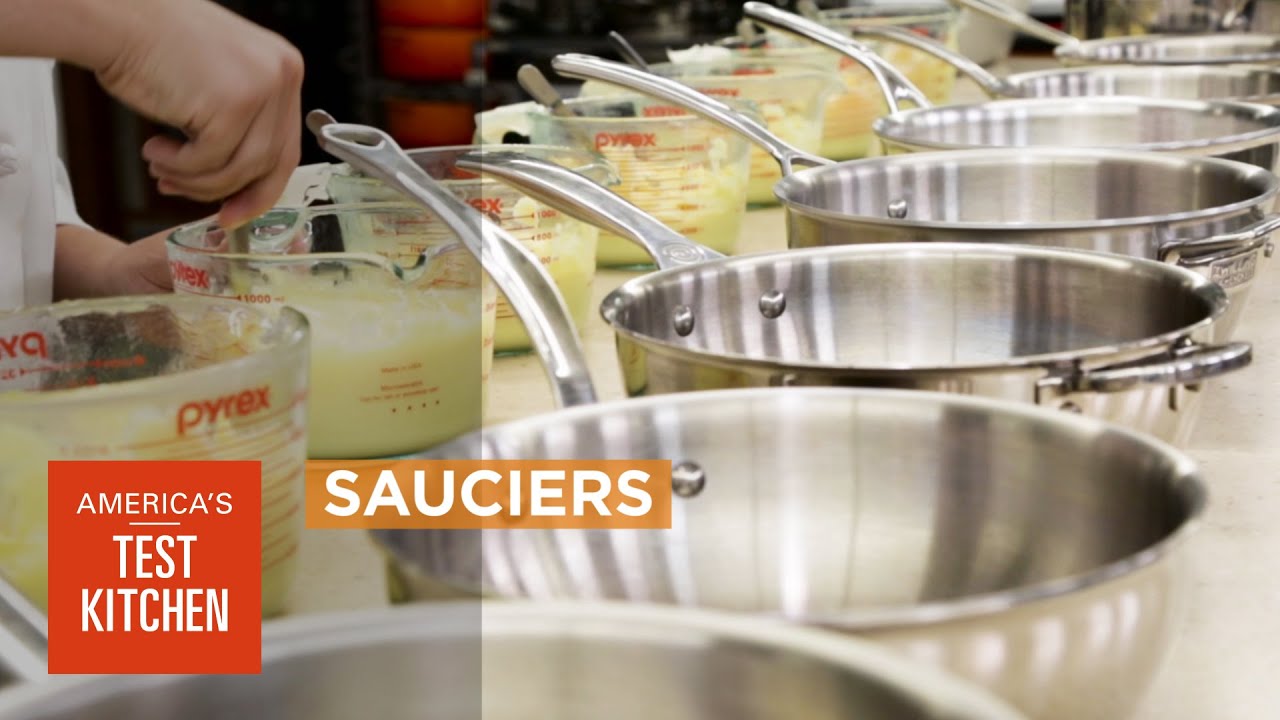
Equipment Review: Best Sauciers (Rounded Saucepans with Wide-Mouth Design) & Our Testing Winner

Buy our Winning Saucier:
Full testing details and ranking chart:
Why you should buy a saucier:
An ordinary saucepan has its uses, but once you experience the ease of stirring in a saucier, you’ll wonder how you ever did without one.
We tested 8 sauciers to find the best one:
Le Creuset 3 1/2 Quart Stainless Steel Saucier Pan
Zwilling J.A. Henckels Aurora 3.5 qt Stainless Steel Saucier
All-Clad Stainless Steel 3-Quart Saucier with Lid
Demeyere Atlantis 3.5 qt Stainless Steel Saucier
Calphalon Tri-Ply Stainless Steel 3-qt Covered Chef’s Pan
Mauviel M’cook Stainless Steel Curved Splayed Saute Pan, Cast Stainless Steel Handle, 3 qt
Paderno World Cuisine Grand Gourmet Stainless Steel Saucier, 3 1/2 Quart
Tramontina 3 Qt. Covered Saucier
What should you look for in a Food Processor? Watch now:
What’s the Best Cast-Iron Skillet? Watch now:
We tested eight sauciers with capacities ranging from 3 to 3 1/2 quarts (the largest common size). In them, we prepared risotto, gravy, and pastry cream, noting their cooking performance as well as how comfortably they handled and how easy they were to clean by hand. Products were purchased online.
PERFORMANCE
We stirred Parmesan risotto, sautéed aromatic vegetables and reduced broth to make gravy, and whisked pastry cream. To test reduction speed, we filled each model with 1,840 grams (about 8 cups) of 75-degree water, timed how long each took to boil over high heat on the same burner, boiled the water for 10 minutes, weighed the results, and repeated the weighing again after 10 more minutes of boiling. Sauciers received high marks if they produced good-quality results in the three recipe tests and offered a relatively broad cooking surface and a rounded shape that made it easy to stir and whisk.
EASE OF USE
We evaluated the length, circumference, and angle of the handles, as well as the weight of the pans (without lids)—all of which contributed to the pans’ ease of use.
CLEANUP
We washed the sauciers by hand throughout testing, noting how easy they were to scrub with a sponge and whether or not they showed any visible scrub marks, scratches, or discoloration.
WINNING TRAITS OF A GOOD SAUCIER
– Relatively Broad Cooking Surface
– Smooth, Curvy, Gently Flared Walls
– Well-Designed Handle
– Moderate Weight
ABOUT US: Located in Boston’s Seaport District in the historic Innovation and Design Building, America’s Test Kitchen features 15,000 square feet of kitchen space including multiple photography and video studios. It is the home of Cook’s Illustrated magazine and Cook’s Country magazine and is the workday destination for more than 60 test cooks, editors, and cookware specialists. Our mission is to test recipes over and over again until we understand how and why they work and until we arrive at the best version.
If you like us, follow us:





So glad to hear them not suggest All-Clad. This Le Creuset looks like a superior pot with a good handle.
ATK seems often to suggest All-Clad over equally good pots or better despite the uncomfortable handle design of All-Clad. I'd have used All-Clad in my kitchen if the handles were better.
I really like the falk culinar solid coppe saucier I have — stainless steel lined. $150 1.4 qt. great for hollandaise sauce etc.
Do you recommend such a large size for someone cooking for one who needs a little wiggle room?
no one outside us & uk use your phoney retarded imperial stoneage system we use the metric system !!!!
"Most countries use the metric system which uses the measuring units such as meters
and grams, and adds prefixes like kilo, milli, and centi to count orders of magnitude.
In the United States, we use the older imperial system, where things are measured in feet, inches, and pounds."
I like buying a saute pan, Its very versatile, You don't need a fry pan or a sauce pot, The saute pan is wide enough to create many dishes.
Talk about dead last and talk about the winner, what about everything else in between ? maybe not everyone wants to spend $200 – $300 on a pan, your research went to waste otherwise.
I just don't understand the pattern you keep doing this.
no best buy?
I’m interested in this risowto. Is it anything like risotto?
any update
I just bought a Viking 40051-1823 Hard Anodized Nonstick Saucier Pan. It's 3 quart. I'm going to have a lot of fun with it, and I wish it had been evaluated in this video.
Saucier or Sauté pan what is the difference they both look very similar to me? If I have a sauté pan do I need a saucier pan and vice versa?
Wait a minute, I thought All Clad had its own 3 qt saucier? 🙂
Who cares about price or affordability? Apparently not American Test Kitchen!
Pay for quality
Go cheap if you can't
Decent cooks
Don't need high-end
Serious cooks do.
I just got a 3.5 qt. Demeyere Atlantis. Pretty tough to beat this one.
Sauce-see-ay. Sounds funny to hear it pronounced like that. It's my great grandfather's surname. We pronounce it Sew-see-ay.
The Le Creuset is too expensive for me, what was the runner up pan?
My 2 Liter Demeyere saucier (Atlantis line) is by far my most used pan. I love it and use it so much, I'm considering buying another one.
Le creuset also has an enameled cast iron saucier. Any reason to consider it? I’m thinking a saucier should probably be only in cladded stainless steel bc it’s lighter and more reactive to temperature changes. Any advantage to a cast iron saucier other than looks?
For $250 I better be using it every day. In fact, it better be doing the cooking and cleaning for $250.
Demeyere is better than Le Creuset. ATK always picks Le Creuset though