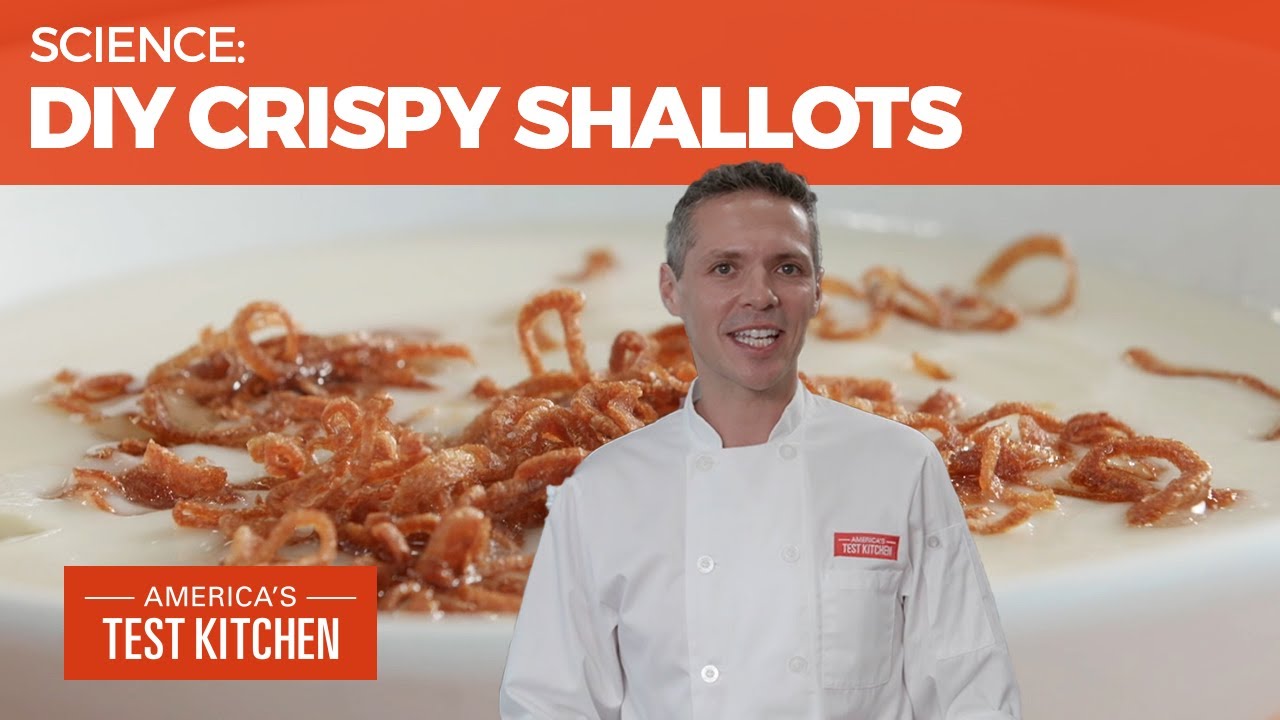
The Easiest Way to Make DIY Crispy Fried Shallots

Joe explains how to make crispy fried shallots.
Get the recipe for Fried Shallots:
Buy our winning large saucepan:
Buy our winning baking sheet:
ABOUT US: Located in Boston’s Seaport District in the historic Innovation and Design Building, America’s Test Kitchen features 15,000 square feet of kitchen space including multiple photography and video studios. It is the home of Cook’s Illustrated magazine and Cook’s Country magazine and is the workday destination for more than 60 test cooks, editors, and cookware specialists. Our mission is to test recipes over and over again until we understand how and why they work and until we arrive at the best version.
If you like us, follow us:
Great video, straight to the point with no bs. This is exactly what I want from a cooking video 👍can't wait to try making these at home
Made this following his directions. No mandolin, just cut with knife (uneven and too thick which added a little more frying time at high heat before it turned golden). 200° F. Turned out perfect, Thanks!
200° ????? WARNING !!!!! If i find you….. I lost 4h of work. Better look behind you in the street.
To all readers, DO NOT dry in oven unless maybe at minimum with window open to be sure!!! This guy better never cross my path… I lost 2 kg for this insanity of a joke!!! I want his address…
Oil layers like in hydrocarbon cracker plants
Bottom most is heavy
Middle is better
Top lighter is like plastic (especially for some items containing inedible palm oil)(oil mix with oil to sink or float)
Crispy is top layer
New oil = is used(high heat high(not peanut oil), smoke point, high auto combustion point) the shallow type of deep frying and slow frying may produce better results. And the bottom sediment oil is fragrant to use to add to some types of soups.
Old oil = Skim top and bottom layer of older oil (carcinogenic over time and usage) mix together for floatsome frying after initial frying with new oil to preserve crispy.ness
what kind of oil do you use to fry the shallots please? thanks
Very helpful – but why ‘SHALLuts’? They should be pronounced ‘shallOTS,’
Just wondering how much does a pack of 250 grams fried shallot cost in the US?
asian will laugh about this…
This is great. I cut up two whole bunches of green onions, fried that up, filtered it, bottled it, and it's awesome on any kind of Asian dish!
How should you store it? And how long will it store for?
Great idea!
Can't wait to try this…I've been doing low carb for 1 1/2 years now (80 pounds less weight) and this is a great way to have crispy shallots without the breading! Love ATK's recipes!
ATK, please specify your temperature scale especially when it's a British voice calling out the temperature. At 200C these shallots would have been toast.
Love shallots.
Is it just me that wonders/worries about how much energy is used to make that little bit of food??
Too much work! I can see why lunch for four can be $350.
It's disturbing to watch virtually all of these TV cooks using a mandolin without the protective device that keeps the fingers away from the blade. I get it that they're professionals and all that but shouldn't they be setting a good example for their amateur audience? It seems to me that they should at least suggest its use for beginners and certainly for kids.
"200 degrees oven"
F / C ?????
Those Kyocera ceramic slicers are a godsend. But, if I'm honest, I'd rather just buy a bag of them from the Asian aisle of the supermarket for a coupla bucks.
I'm curious what are the other uses for that shallot oil? Along with how do you store it/for how long?
His accent is perfection
My family have been fruing shallots all our lives for decades and our fried shallots keep for a couple of months in air tight container and stay crispy WITHOUT NEEDING TO FINISH DRYING EVEN FOR A SECOND IN THE OVEN. Why all the complicated process? Slice shallots thinly, fry over low medium heat until lightly golden and turn off the heat immediately. Strain the oil off and spread the fried shallots on paper towel. Leave to drain and cool on paper towel, around 15 mins. Store in air tigh container. Never had soggy fried shallots all these decades AND we live in a tropical humid climate.
Thanks for these instructions. It would be awesome to get specific ideas/recipes on using the oil.
thanks, Joe!
I love crispy shallots, but there's no way in hell I'm spending an hour to make them!
Looks like those fried shallots and flavored oil were put over vichyssoise at the end of the video — yum!
Now he's a bit of interesting. Who is he? Want to see more of him!
Serious eats microwave technique:
Combine sliced shallots or chopped garlic with a neutral oil like canola in a microwave-safe bowl, cook at full power for 5 minutes, give them a stir, and continue to cook in 1 to 2 minutes increments, stirring between each round, until they are lightly golden. At this point, carefully remove the bowl from the microwave, strain the oil into a heatproof container, and lay out your crispy bounty onto paper towels, giving them a sprinkling of salt
I'm making Crispy Shallot Hummus next.
I made your crispy onions from the ATK Mediterranean cookbook which called for microwaving the sliced onions for 5 mins, then making sure they were very dry before frying in the oil. They came out great! But this recipe seems easier, so I'll try it.
Love this! TYVM
Is it worth the effort of making it rather than just buying them from an asian supermarket? (If one's availavle of course)
Wait – what if you put them in the oven FIRST to drive off the moisture, then fried them for a shorter time?
Those shallots go well as a topping on Phillipine or Pinoy cooking, as well as Thai dishes 😍
Why make it if you’re not going to eat it.
How to make bawang goreng from home.
I have a couple questions, aside from why anyone would have cooking oil "destined for the trash." Only wasteful, wealthy, ignorant people would throw out barely used oil. My questions are these: What is 1/16 inch in millimetres, and with your oven, are you talking 200°F or Centigrade? I am Anerican, and never entirely understood the Imperial system of measuring, beyond gas in gallons, inches/feet for short measurements, and pounds for body weight, and liquid measurements for cooking. Otherwise, I learned the metric system in elementary school, and have used it for about 43 years. I do cooking measures in liquid cups/ounces, usually, but I can't understand people talking about liquor in old fashioned measurements, like a pint, other than beer, because I grew up with millilitres and Litres. If you would, could you please state measurements and temps in both Imperial and Metric? That would lessen confusion, and make your videos more accessible for a global audience. Thanks.
Alternately, ATK-o-philes, dredge thinly hand-gunned shallots with rice flour, conventional deep fry and get gangster quicker.
Dry in an oven for 2 hours???…..
Forget that noise!
I need that bird’s nest yesterday!
The karate chop hand motions are extra.
Yessss we love to see Joe!
Helen Rennie suggests salting the sliced shallots about an hour before frying, which seasons them more thoroughly than salting afterward. I’ve tried both ways, and it makes a big difference.
So simple! Please share recipes and ideas for using the oil. How long will the oil last and how should it be stored?
Don't throw out the oil – we'll come back to that
me expecting a list of potential uses
he comes back to the oil: You can use it in many ways!
– ehm, you didn't really need to come back to this to essentially just repeat: don't throw it out… -_-.
anyone else wince at the using of a mandoline with no hand protection or other equipment
炸油蔥酥是個好東西,可以讓許多食物增添許多的香氣。
Um ~!
This color is only afraid that it has been blown too long.
This fried shallots should be removed in the "Golden Color", not turning into a red brown.
Wow, this is so different from what I'm used to. We coat the shallots with flour and deep-fry them. Most of the time they are used as a garnish for mashed potatoes. I can't wait to try this technique from the video
Like the host. Hope to see more of him. On the TV show?
Isn’t it interesting that garnish has different meanings in different kitchens? I have always thought of them as decoration for any dish. But watching Hell’s Kitchen, I discovered that Ramsey et al thought of them as side dishes. The things you learn..:)